Greater Noida has evolved considerably since its development as a planned extension of the National Capital Region.
For many years, the city’s growth story was largely associated with planned residential sectors, educational institutions, commercial centres, expressways and expansion of the wider NCR urban footprint.
A different type of growth is now becoming increasingly important around the DMIC Greater Noida corridor.
Here, residential development is being accompanied by industrial infrastructure, logistics facilities, freight connectivity and larger regional economic planning.
The distinction is important.
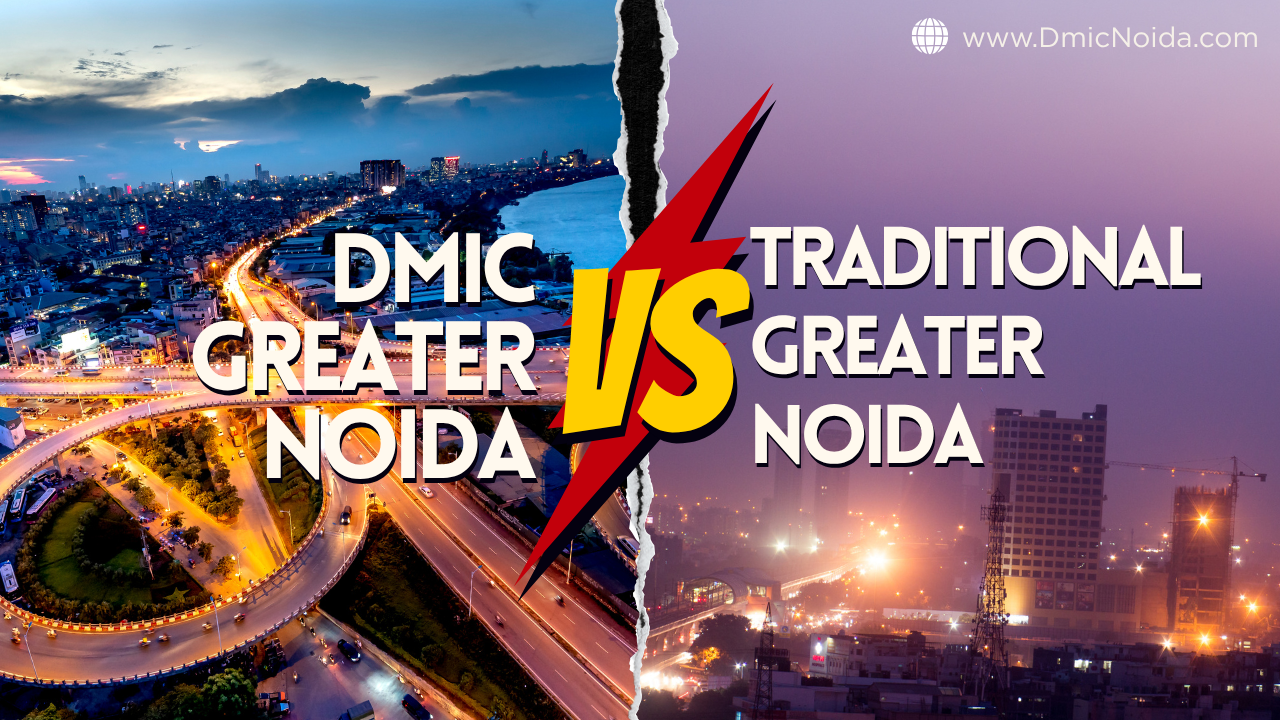
Traditional Greater Noida growth has been strongly urban and residential-led, while the DMIC ecosystem is being developed around a broader combination of industry, logistics, transportation and urban infrastructure.
At a Glance: Two Different Growth Models
| Factor | Traditional Greater Noida Growth | DMIC Greater Noida Growth |
|---|---|---|
| Primary driver | Urban & residential expansion | Industrial + economic development |
| Housing | Major component | Supporting component of wider ecosystem |
| Industry | Present across the city | Central to the DMIC model |
| Logistics | Supporting infrastructure | Strategic component |
| Freight connectivity | Regional | Major planning consideration |
| Road connectivity | Important | Critical to industrial movement |
| Rail connectivity | Supporting | Important for freight and passenger movement |
| Employment | Diverse urban employment | Industrial, logistics + supporting employment |
| Development pattern | Sector-based urban expansion | Integrated economic ecosystem |
| Long-term focus | City development | Industry + infrastructure + urbanisation |
This does not mean that one model is replacing the other.
Instead, the DMIC corridor represents an additional layer in Greater Noida’s development.
What Is DMIC Greater Noida?
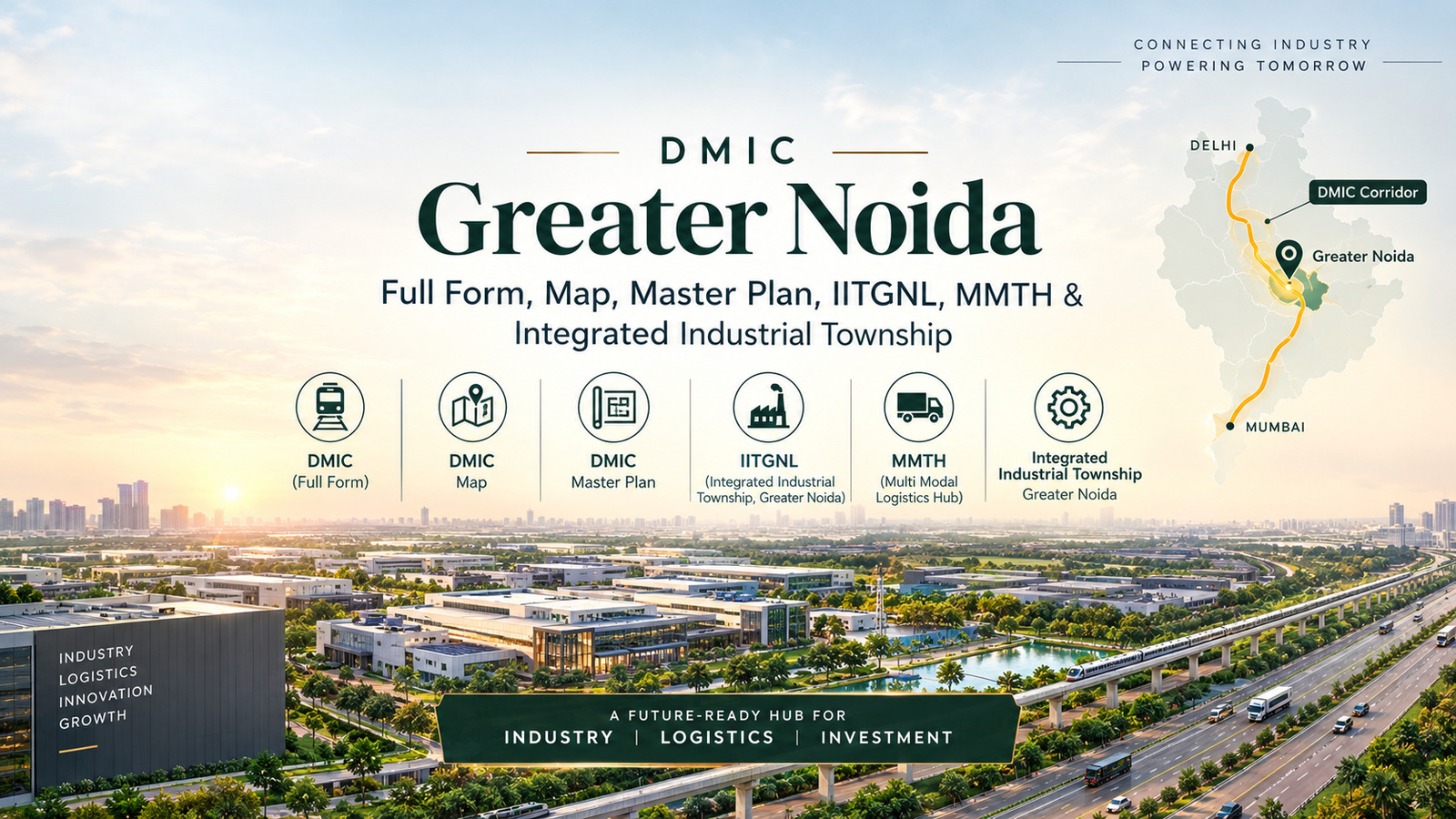
The Integrated Industrial Township–Greater Noida is a flagship project under the Delhi-Mumbai Industrial Corridor framework.
According to the National Industrial Corridor Development Corporation, the township spans approximately 747 acres and is located southeast of Greater Noida.
The site abuts the Eastern Peripheral Expressway and Delhi–Howrah railway line and is approximately 11 km from Pari Chowk.
Its location also places it near the Boraki transit hub and Dadri logistics ecosystem.
The township has been planned around industrial sectors including electronics, white goods, mobile manufacturing, biotechnology, research and development, engineering and robotics.
This industrial orientation is what makes the DMIC growth story different from conventional residential expansion.
Traditional Greater Noida: The Planned City Model
Greater Noida was conceived as a planned urban extension of the NCR.
Its development has included:
- Residential sectors
- Institutional areas
- Commercial centres
- Educational institutions
- Roads and expressways
- Parks and green areas
- Industrial areas
- Public infrastructure
The residential sector has been an important part of this model.
People move into the city.
Housing is developed.
Retail and services follow.
Educational and institutional infrastructure expands.
The city gradually becomes more self-sufficient.
This is a conventional urbanisation model.
DMIC Greater Noida: The Economic-Corridor Model
The DMIC model adds another starting point.
Instead of beginning primarily with housing, the development model places economic activity and industrial infrastructure at the centre.
The sequence can be represented as:
Industrial Infrastructure
↓
Businesses & Manufacturing
↓
Employment
↓
Supporting Services
↓
Population Movement
↓
Housing Demand
↓
Urban Ecosystem
This does not guarantee that every stage will occur at the same speed.
But it explains why industrial corridors can eventually create residential and commercial requirements around employment centres.
Why Industry Changes the Development Equation
A conventional residential development primarily needs people who want to live there.
An industrial corridor needs:
- Companies
- Employees
- Suppliers
- Logistics providers
- Contractors
- Service businesses
- Technical professionals
- Management
- Supporting infrastructure
This creates multiple categories of potential users of the surrounding urban ecosystem.
Example
A manufacturing company may employ engineers.
Engineers require housing.
Employees need transport.
Transport creates demand for services.
Services require additional employees.
Those employees also require housing.
This creates a broader economic cycle.
The Importance of Logistics
The DMIC Greater Noida story cannot be separated from logistics.
The Dadri region is strategically important because of its connection to freight infrastructure.
NICDC describes the planned Multi Modal Logistics and Transport Hub at Dadri as an approximately 825-acre development positioned near the intersection of the Eastern and Western Dedicated Freight Corridors.
Its planned functions include:
- Warehousing
- Freight handling
- Customs clearance
- Value-added logistics services
- Supply-chain operations
This creates an important connection between industrial production and distribution.
Connectivity: Another Major Difference
Traditional residential development generally prioritises:
- Daily commuting
- Metro/road access
- Schools
- Markets
- Offices
- Healthcare
An industrial corridor needs these facilities too, but adds another requirement:
freight movement.
That makes the transport network more complex.
| Requirement | Residential Area | Industrial Corridor |
|---|---|---|
| Passenger movement | High | High |
| Employee commuting | High | Very high |
| Freight movement | Moderate | Very high |
| Warehousing | Limited | Important |
| Rail freight | Limited relevance | Strategic |
| Road logistics | Supporting | Critical |
| Airport connectivity | Lifestyle/business | Business + cargo potential |
This is why the presence of expressways, railway infrastructure and logistics hubs becomes particularly relevant to DMIC Greater Noida.
The Role of the Eastern Peripheral Expressway
The DMIC township directly benefits from its relationship with the Eastern Peripheral Expressway.
NICDC identifies the township as abutting the EPE.
For an industrial area, this provides an important regional road connection for movement between different NCR markets.
The benefit is not simply for residents.
It can also support:
- Commercial vehicles
- Industrial suppliers
- Distribution
- Logistics
- Employee movement
- Regional business activity
This creates a more comprehensive connectivity ecosystem.
Why Residential Development Still Matters
An industrial corridor cannot operate independently of housing.
Workers need homes.
Managers need homes.
Business owners need homes.
Service providers need homes.
Families of employees need schools, healthcare and retail.
That is why residential development can become an important supporting component of industrial urbanisation.
Godrej Properties’ acquisition of a 23.2-acre residential parcel within the DMIC Integrated Township is an important recent example.
The company won the parcel through an e-auction, and the proposed housing development has been reported with an estimated revenue potential of more than ₹7,000 crore.
The significance is not simply the size of the proposed development.
It is also the location within a planned industrial ecosystem.
Godrej Properties and the Changing Development Narrative
The entry of a major developer into the DMIC township provides another indication that residential development is becoming part of the area’s broader economic narrative.
The proposed development is associated with the Godrej Global Business City / Godrej DMIC Greater Noida identity in market-facing material.
However, the larger story is regional.
The project sits within an ecosystem involving:
DMIC Industrial Township
Eastern Peripheral Expressway
Delhi–Howrah Railway
Dadri Logistics
Greater Noida
Wider Airport-Linked Development
That makes the development relevant beyond its individual project boundaries.
Does DMIC Automatically Mean Higher Property Prices?
No.
This is an important distinction.
Infrastructure and industrial development can create conditions that support economic growth, but they do not guarantee property appreciation.
Actual property performance can depend on:
- Demand
- Supply
- Pricing
- Employment
- Project execution
- Infrastructure delivery
- Regulatory approvals
- Financing conditions
- Local amenities
- Broader economic conditions
Therefore, DMIC should be viewed as an economic-development framework, not a guarantee of investment returns.
The Bigger Difference
The easiest way to understand the difference is:
Traditional Greater Noida is primarily a planned city-development story. DMIC Greater Noida adds an industrial and logistics-led economic-development layer to that story.
That distinction could become increasingly important as industrial activity, logistics infrastructure and residential development progress together.
What Could the Next Phase Look Like?
The potential sequence is:
Phase 1
Industrial infrastructure
Phase 2
Business and manufacturing activity
Phase 3
Employment creation
Phase 4
Supporting commercial services
Phase 5
Residential expansion
Phase 6
More integrated urban development
The actual timing of these stages will depend on investment, implementation and market conditions.
Greater Noida’s development story is no longer limited to residential sectors and urban expansion.
The DMIC Integrated Township introduces a different development model built around industry, logistics, freight connectivity and economic infrastructure.
The approximately 747-acre township, its proximity to the Eastern Peripheral Expressway and Delhi–Howrah railway line, and its relationship with the Dadri logistics ecosystem give the area a distinctly economic-corridor character.
The recent entry of Godrej Properties through its 23.2-acre residential land parcel adds another dimension to this evolution.
Rather than viewing DMIC Greater Noida simply as another residential location, it is more useful to understand it as part of a developing industry–logistics–employment–housing ecosystem.
Frequently Asked Questions
What makes DMIC Greater Noida different from traditional Greater Noida?
DMIC Greater Noida is centred around an integrated industrial ecosystem combining manufacturing, logistics and infrastructure with residential and commercial development.
How large is the DMIC Integrated Township?
NICDC lists the Integrated Industrial Township–Greater Noida at approximately 747 acres.
Why is residential development important near industrial areas?
Industrial activity can create employment, which can generate demand for housing and supporting services.
What role does Godrej Properties play in this development?
Godrej Properties won a 23.2-acre residential land parcel within the DMIC Integrated Township through an e-auction. The proposed development has an estimated revenue potential exceeding ₹7,000 crore.
Does DMIC guarantee property appreciation?
No. Infrastructure and economic development are factors that can influence a market, but they do not guarantee appreciation or investment returns.
buying property DMIC Greater Noida Dadri DFC Dadri logistics hub Dadri MMLH DMIC 2030 DMIC companies in Greater Noida DMIC connectivity DMIC corridor investment DMIC electronics industry DMIC employment opportunities DMIC Greater Noida DMIC Greater Noida 2030 DMIC Greater Noida 2040 DMIC Greater Noida airport DMIC Greater Noida apartments DMIC Greater Noida companies DMIC Greater Noida connectivity DMIC Greater Noida development DMIC Greater Noida industries DMIC Greater Noida investment DMIC Greater Noida jobs DMIC Greater Noida logistics DMIC Greater Noida property DMIC Greater Noida residential demand DMIC Integrated Township DMIC real estate investment Godrej DMIC Greater Noida Godrej Global Business City Godrej Properties Greater Noida Godrej residential development Greater Noida industrial corridor Greater Noida industrial development Greater Noida industrial investment Greater Noida logistics hub Greater Noida logistics infrastructure Greater Noida manufacturing hub Greater Noida warehousing Hero Homes DMIC Contact Number Hero Homes DMIC Floor Plans Hero Homes DMIC Master Plans Hero Homes DMIC Payment Plan Integrated Industrial Township Greater Noida logistics companies Greater Noida manufacturing Greater Noida MMLH Greater Noida