When people discuss the future of Greater Noida, the conversation often focuses on roads, housing, expressways and real estate.
But one of the most important factors behind long-term urban growth is often overlooked:
employment.
People generally move toward economic opportunities.
Businesses follow infrastructure.
Infrastructure attracts investment.
Investment creates employment.
And employment can eventually influence housing, retail, education, healthcare and other services.
This is why the development of the DMIC Greater Noida corridor deserves attention from people interested not only in real estate, but also in the region’s future economic structure.
What Is Creating the Employment Opportunity?
The employment story around DMIC Greater Noida is not based on a single project.
It comes from the combination of:
- Industrial development
- Manufacturing
- Logistics
- Warehousing
- Freight movement
- Research and development
- Engineering
- Electronics
- White goods
- Transportation
- Supporting services
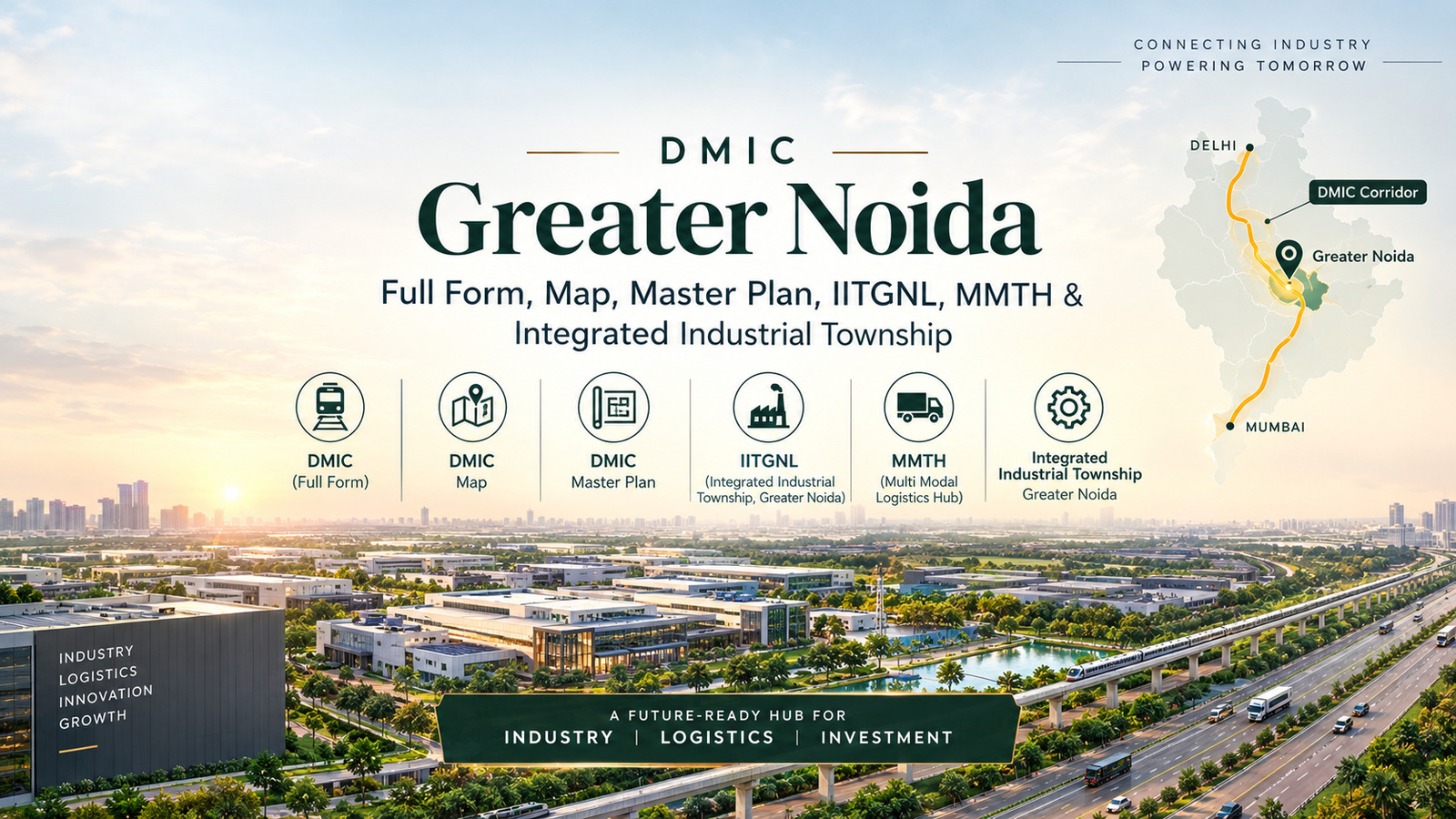
The Integrated Industrial Township–Greater Noida covers approximately 747 acres, according to NICDC.
The organisation identifies focus sectors including electronics, white goods, mobile manufacturing, biotechnology, R&D, engineering and robotics.
Employment Ecosystem at a Glance
| Sector | Potential Employment Categories |
|---|---|
| Electronics | Engineers, technicians, production staff |
| White Goods | Manufacturing, quality control, operations |
| Engineering | Technical, production and maintenance |
| Robotics | Engineers, technicians, R&D |
| Biotechnology | Scientists, technicians, support staff |
| Logistics | Supply-chain, warehousing and operations |
| Warehousing | Supervisors, operators, administration |
| Transportation | Drivers, fleet management, logistics |
| Services | Retail, food, healthcare, education |
These are potential employment categories, not forecasts of specific job numbers.
Direct vs Indirect Employment
Industrial investment can create two broad categories of employment.
Direct employment
These are jobs within manufacturing plants, industrial facilities, logistics centres and businesses.
Examples include:
- Production workers
- Engineers
- Technicians
- Managers
- Quality-control staff
- R&D professionals
- Administrative employees
Indirect employment
These jobs support the businesses and employees.
Examples include:
- Transport
- Security
- Food services
- Maintenance
- Cleaning
- Retail
- Accommodation
- Healthcare
- Education
- Professional services
This second layer is important because economic development can extend beyond factory gates.
Why Manufacturing Can Create a Wider Ecosystem
Consider a hypothetical electronics manufacturing unit.
The factory requires:
Engineers
Technicians
Production workers
Quality-control staff
Procurement
Administration
But it may also require:
Transport
Packaging
Maintenance
Security
Catering
Equipment suppliers
Logistics
Each layer creates additional economic activity.
This is one reason industrial clusters can influence surrounding urban development.
The Role of Logistics
Greater Noida’s logistics potential is particularly important because the region is connected to major road and rail infrastructure.
NICDC’s planned Multi Modal Logistics and Transport Hub at Dadri covers approximately 825 acres and is positioned near the Eastern and Western Dedicated Freight Corridors.
The hub is designed around freight-related functions including:
- Warehousing
- Customs
- Freight handling
- Value-added logistics
- Distribution
A logistics hub can create employment across several skill levels.
Logistics Employment Categories
| Category | Examples |
|---|---|
| Operations | Warehouse management |
| Transportation | Fleet operations |
| Supply Chain | Planning & coordination |
| Technology | Warehouse management systems |
| Customs | Documentation & compliance |
| Maintenance | Equipment and facility maintenance |
| Administration | Accounts & office operations |
| Support | Security, food and housekeeping |
This creates an employment ecosystem that can complement manufacturing.
Why the Eastern Peripheral Expressway Matters
Industrial businesses need reliable transportation.
The DMIC township’s proximity to the Eastern Peripheral Expressway provides an important road connection to the wider NCR network.
This matters for:
- Raw materials
- Finished products
- Employee commuting
- Supplier movement
- Distribution
- Commercial vehicles
Road infrastructure therefore supports employment indirectly by making industrial operations more practical.
Rail Connectivity and Employment
NICDC also identifies the Delhi–Howrah railway line as a major connectivity feature of the Integrated Industrial Township.
Rail connectivity is particularly relevant to an industrial corridor because freight movement can be a critical component of supply chains.
The combination of road and rail creates a more diversified transport ecosystem.
Noida International Airport: Another Economic Layer
The wider region is also being shaped by Noida International Airport and YEIDA’s long-term planning.
Airport development can create employment in:
- Aviation
- Cargo
- Ground handling
- Security
- Hospitality
- Retail
- Logistics
- Transportation
- Maintenance
- Business services
Airport-led employment can therefore complement industrial and logistics employment.
The Three Employment Engines
Greater Noida’s emerging economic ecosystem can be broadly represented through three major engines:
| Engine | Primary Activity |
|---|---|
| DMIC Industrial Township | Manufacturing & industry |
| Dadri Logistics Ecosystem | Freight & warehousing |
| Airport Region | Aviation, cargo & supporting services |
Together, they can create a broader employment base than any one sector alone.
How Employment Can Influence Housing
Employment and housing are closely connected.
A simple relationship is:
New Business
↓
New Jobs
↓
Employee Relocation / Local Workforce
↓
Housing Requirement
↓
Retail & Services
↓
Urbanisation
This does not mean every job automatically creates a nearby home.
People may commute from existing NCR cities.
But as employment clusters become larger, housing demand within reasonable commuting distance can become increasingly relevant.
Why Different Income Groups Matter
Employment growth does not create demand for only one type of housing.
Different jobs require different housing segments.
| Employment Group | Potential Housing Preference |
|---|---|
| Industrial workers | Affordable / rental housing |
| Supervisors | Mid-segment housing |
| Engineers | Mid/premium housing |
| Managers | Premium housing |
| Senior professionals | Premium/luxury housing |
| Entrepreneurs | Residential + commercial ecosystem |
This is why an employment-led corridor can eventually develop a diversified housing market.
What About Rental Housing?
Rental demand can emerge before ownership demand.
Employees relocating from other cities may initially rent because they:
- Want flexibility
- Are testing the location
- Have recently moved for work
- Are waiting for family relocation
- Are not ready to purchase
Over time, some of these households may transition into ownership.
However, actual rental demand needs to be measured through market data rather than assumed.
The Importance of Skills
Industrial growth also creates demand for skill development.
The region may require:
- Technical training
- Engineering skills
- Logistics management
- IT systems
- Manufacturing operations
- Quality control
- Supply-chain expertise
A stronger local skills ecosystem can make the region more attractive to employers.
Why the Employment Story Is Bigger Than DMIC
The DMIC township is one component of a larger NCR economic geography.
Greater Noida is increasingly connected to:
- Noida
- Delhi
- Ghaziabad
- Yamuna Expressway region
- Dadri
- Jewar
- Western Uttar Pradesh
- NCR logistics networks
Therefore, employment generated in one node can potentially support businesses and housing across a much wider area.
Godrej Properties as an Indicator of Residential Integration
The recent Godrej Properties acquisition provides an interesting example of the relationship between employment-led development and residential planning.
Godrej Properties won a bid for a 23.2-acre residential parcel within the DMIC Integrated Township.
The proposed project has been reported with estimated revenue potential exceeding ₹7,000 crore.
The significance is not that this project itself will create a specific number of jobs; no reliable public source currently establishes such a figure.
Its significance is that a major residential developer is entering an area whose broader development model is strongly connected to industry and infrastructure.
What Could Employment Mean for Greater Noida?
If industrial and logistics development continues, several effects could potentially emerge:
More businesses
New businesses can create demand for supporting services.
More workers
Employment can increase the local and regional workforce.
More services
Retail, food, healthcare and education can expand.
More transportation
Employee and freight movement can increase.
More housing demand
Workers and families require accommodation.
More urban integration
Industrial areas can gradually become part of a larger urban ecosystem.
Important Reality Check
It is important not to confuse planned employment potential with actual employment.
There is a difference between:
- Announced projects
- Planned projects
- Under-construction projects
- Operational businesses
- Actual jobs
For anyone evaluating the region, operational data is more meaningful than announcements.
The same principle applies to housing.
What Should People Watch?
The most useful indicators over the coming years will include:
| Indicator | Why It Matters |
|---|---|
| Industrial occupancy | Shows business activity |
| New company investments | Indicates economic expansion |
| Employment numbers | Measures actual job creation |
| Logistics operations | Shows freight ecosystem maturity |
| Airport operations | Measures aviation impact |
| Housing absorption | Indicates residential demand |
| Rental activity | Shows workforce movement |
| Retail development | Indicates population growth |
These indicators provide a more reliable picture than simply counting project announcements.
The employment story around DMIC Greater Noida is ultimately a story about economic diversification.
The region combines a planned industrial township with logistics infrastructure, road and rail connectivity and the broader airport-led development of the Yamuna region.
The Integrated Industrial Township’s focus on sectors such as electronics, white goods, engineering, biotechnology, R&D and robotics creates the possibility of a diverse employment base.
The Dadri logistics ecosystem can add another layer through warehousing, freight and supply-chain activity.
Residential development then becomes an important supporting component.
The arrival of Godrej Properties on a 23.2-acre residential parcel is one example of how housing development is beginning to intersect with this wider economic story.
The real measure of success, however, will be actual businesses, actual employment and actual infrastructure delivery.
Frequently Asked Questions
What industries are planned in the DMIC Greater Noida township?
NICDC identifies sectors including electronics, white goods, mobile manufacturing, biotechnology, R&D, general engineering and robotics.
Can DMIC Greater Noida create employment?
The industrial and logistics ecosystem has the potential to generate direct and indirect employment, although specific future job numbers should not be treated as guaranteed.
How can logistics create jobs?
Logistics supports warehousing, transportation, supply-chain management, customs, equipment maintenance and numerous support services.
Can employment increase housing demand?
Potentially. A growing workforce can increase requirements for rental and ownership housing, although the scale depends on actual employment and population growth.
Is Godrej’s project an employment project?
No. Godrej Properties’ development is a residential project. Its relevance to employment comes from its location within a broader industrial and economic ecosystem.
buying property DMIC Greater Noida Dadri DFC Dadri logistics hub Dadri MMLH DMIC 2030 DMIC companies in Greater Noida DMIC connectivity DMIC corridor investment DMIC electronics industry DMIC employment opportunities DMIC Greater Noida DMIC Greater Noida 2030 DMIC Greater Noida 2040 DMIC Greater Noida airport DMIC Greater Noida apartments DMIC Greater Noida companies DMIC Greater Noida connectivity DMIC Greater Noida development DMIC Greater Noida industries DMIC Greater Noida investment DMIC Greater Noida jobs DMIC Greater Noida logistics DMIC Greater Noida property DMIC Greater Noida residential demand DMIC Integrated Township DMIC real estate investment Godrej DMIC Greater Noida Godrej Global Business City Godrej Properties Greater Noida Godrej residential development Greater Noida industrial corridor Greater Noida industrial development Greater Noida industrial investment Greater Noida logistics hub Greater Noida logistics infrastructure Greater Noida manufacturing hub Greater Noida warehousing Hero Homes DMIC Contact Number Hero Homes DMIC Floor Plans Hero Homes DMIC Master Plans Hero Homes DMIC Payment Plan Integrated Industrial Township Greater Noida logistics companies Greater Noida manufacturing Greater Noida MMLH Greater Noida