For decades, the development of Indian cities has often followed a familiar pattern: residential neighbourhoods expand first, while employment centres, logistics infrastructure and commercial districts develop separately.
The emerging development model around DMIC Greater Noida represents something different.
The Integrated Industrial Township–Greater Noida has been planned as part of the Delhi–Mumbai Industrial Corridor ecosystem, combining industrial activity, logistics, transportation infrastructure and urban-support infrastructure within a broader economic development framework.
The recent entry of Godrej Properties into this ecosystem adds another important dimension.
In June 2026, Godrej Properties emerged as the successful bidder for a 23.2-acre residential land parcel within the DMIC Integrated Township. The company said the proposed residential group housing development has an estimated revenue potential of more than ₹7,000 crore, based on current business assumptions.
This development raises a bigger question:
Could Greater Noida be moving from a conventional residential expansion model towards a more integrated “live-work-connect” urban ecosystem?
1. What Makes the DMIC Greater Noida Model Different?
The Integrated Industrial Township is not simply another residential sector.
Its broader objective is to create an environment where industrial production, logistics, employment and supporting urban infrastructure can operate together.
This creates a potentially different demand structure.
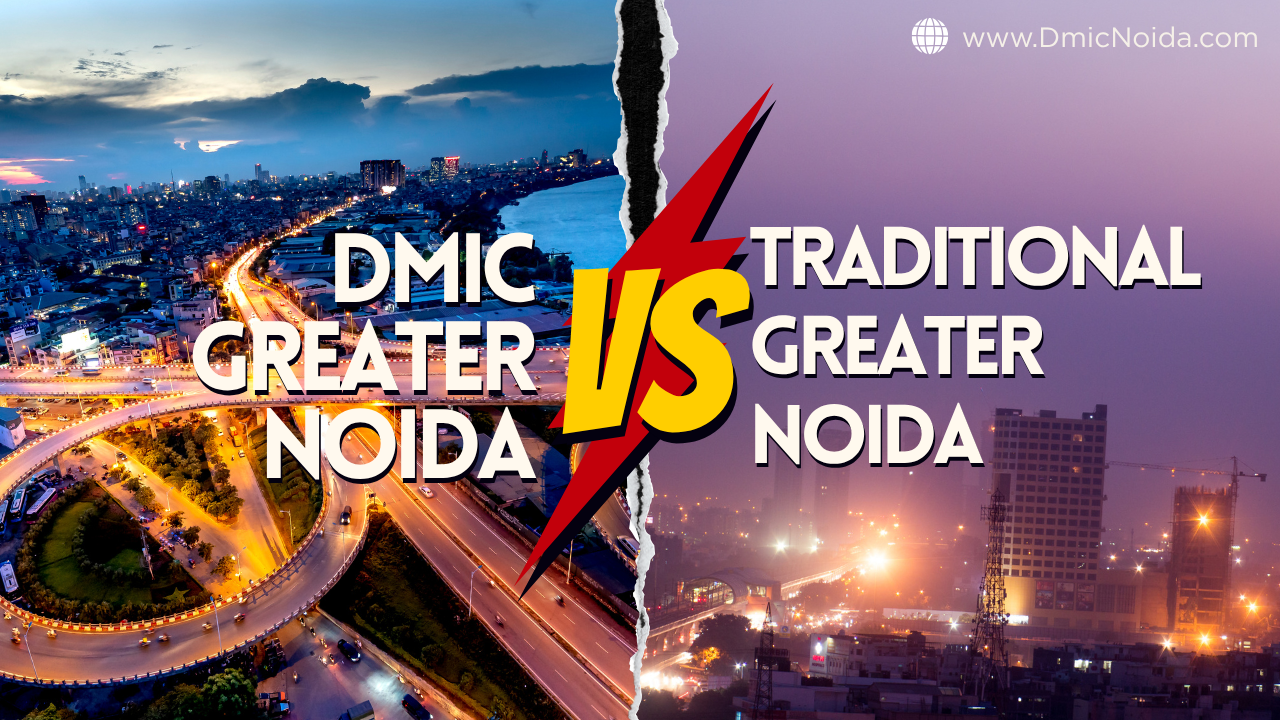
| Traditional Residential Growth | Emerging DMIC-Oriented Model |
|---|---|
| Residential development | Residential + employment ecosystem |
| Housing-led expansion | Industry-led economic expansion |
| Local commuting | Regional employment connectivity |
| Retail-focused activity | Manufacturing + logistics + services |
| Residential infrastructure | Industrial + logistics + urban infrastructure |
| Demand driven mainly by homebuyers | Potential demand from employees, professionals, businesses and families |
This does not mean that every property inside or around Greater Noida will automatically benefit.
Instead, the important point is that the source of future demand could become more diversified.
2. Why Employment Matters for Residential Development
Residential markets generally become stronger when they are supported by sustainable employment.
An industrial corridor can create multiple layers of employment:
Direct employment
These may include:
- Manufacturing
- Engineering
- Electronics
- Industrial operations
- Research and development
- Quality control
- Technical services
Indirect employment
The economic ecosystem can also support:
- Logistics
- Warehousing
- Transportation
- Maintenance
- Hospitality
- Retail
- Professional services
- Facility management
- Construction
- Business services
Supporting urban demand
As employment expands, employees and businesses require:
- Housing
- Schools
- Healthcare
- Retail
- Restaurants
- Recreation
- Transportation
- Daily services
This is where residential development can become part of a much larger economic cycle.
3. Godrej Properties Adds a Residential Layer
The Godrej Properties land parcel is particularly interesting because it introduces a major residential development into an industrially oriented economic ecosystem.
The company won the 23.2-acre parcel through an e-auction conducted by DMIC Integrated Industrial Township Greater Noida Limited.
The proposed development is planned as a residential group housing project.
The stated estimated revenue potential of more than ₹7,000 crore should be understood correctly.
Important distinction
₹7,000+ crore is an estimated revenue potential — not guaranteed sales, profit, appreciation or investor returns.
This distinction is important when evaluating the significance of the project.
The more meaningful question is what the development says about the evolving structure of Greater Noida.
4. From “Where Do People Live?” to “Where Do People Live and Work?”
One of the most important changes in modern urban planning is the relationship between employment and housing.
A successful economic zone does not only attract companies.
It eventually needs an ecosystem around those companies.
Consider the potential cycle:
Industrial investment
↓
Employment creation
↓
Employee migration / local workforce growth
↓
Housing demand
↓
Retail & services
↓
Social infrastructure
↓
More attractive economic environment
↓
Further investment
This is why the residential component of an industrial township can be strategically important.
5. The Logistics Factor
DMIC Greater Noida is also positioned within a wider logistics network.
The broader region connects with important transportation infrastructure, including the Eastern Peripheral Expressway, Yamuna Expressway, dedicated freight infrastructure and logistics facilities around Dadri.
The objective of such infrastructure is not merely faster passenger movement.
It is also about moving:
- Raw materials
- Manufactured products
- Components
- Finished goods
- Export cargo
- Warehousing inventory
For businesses, logistics efficiency can influence operating costs and supply-chain decisions.
For cities, this can influence where employment centres emerge.
6. Why This Matters for Residential Demand
A residential market supported by multiple economic drivers can be structurally different from one driven primarily by speculative expectations.
Potential residential demand around an economic corridor can come from:
| Demand Segment | Potential Requirement |
|---|---|
| Industrial employees | Affordable & mid-segment housing |
| Managers & professionals | Premium apartments |
| Senior executives | Larger homes |
| Business owners | Premium residential options |
| Investors | Rental-oriented opportunities |
| Logistics workforce | Convenient housing |
| Service-sector employees | Housing near employment zones |
| Migrating families | Schools, healthcare & community facilities |
This creates a broader potential customer base.
7. Why the Godrej Entry Is Worth Watching
Godrej Properties’ entry should not be interpreted as proof that property prices will automatically rise.
However, a major national developer choosing a sizeable residential parcel inside an industrial township is noteworthy.
It demonstrates that residential development is increasingly being considered alongside the region’s larger economic infrastructure.
The significance therefore goes beyond the individual project.
It is about the possibility of residential real estate becoming integrated with the economic growth story of Greater Noida.
8. Greater Noida’s Next Development Phase
Greater Noida has already developed substantial residential, institutional and commercial infrastructure.
The next stage could increasingly be influenced by:
- Manufacturing
- Logistics
- Airport-related activity
- Industrial employment
- Warehousing
- Data and technology infrastructure
- Commercial development
- Regional transportation
This makes the region increasingly relevant to people who evaluate real estate through an economic-development lens, rather than simply looking at today’s neighbourhood infrastructure.
Key Takeaway
The biggest story around DMIC Greater Noida may not be a single residential project.
It may be the emergence of a new urban-development model.
The combination of:
Industry + Logistics + Employment + Infrastructure + Housing
can potentially create a more complete economic ecosystem.
Godrej Properties’ proposed residential development inside the DMIC Integrated Township adds an important residential component to that story.
For homebuyers and investors, the important exercise is not simply asking “What is the price today?”
A more meaningful question is:
“What economic ecosystem is being built around the location?”
That is the question that could define the next phase of Greater Noida’s growth.
Frequently Asked Questions
Is DMIC Greater Noida only an industrial area?
No. The broader DMIC ecosystem includes industrial, logistics, transportation and supporting urban-development components. The Integrated Industrial Township is designed as an economic ecosystem rather than simply a conventional residential locality.
What is Godrej Properties planning in DMIC Greater Noida?
Godrej Properties won a 23.2-acre residential land parcel within the DMIC Integrated Township and has stated that it plans to develop a residential group housing project.
What is the ₹7,000 crore figure associated with the project?
Godrej Properties has indicated an estimated revenue potential of more than ₹7,000 crore based on current business assumptions. It should not be interpreted as guaranteed profit or investment return.
Why is residential development important inside an industrial ecosystem?
Industrial and logistics investment can create employment. Housing, retail, healthcare, education and other services can then develop around the workforce, creating a broader urban ecosystem.
Does DMIC automatically mean property prices will appreciate?
No. Infrastructure and economic development can support long-term demand, but property appreciation depends on multiple factors including project quality, supply, actual employment growth, infrastructure completion, regulations, market conditions and pricing.