Introduction: Why DMIC Greater Noida Matters
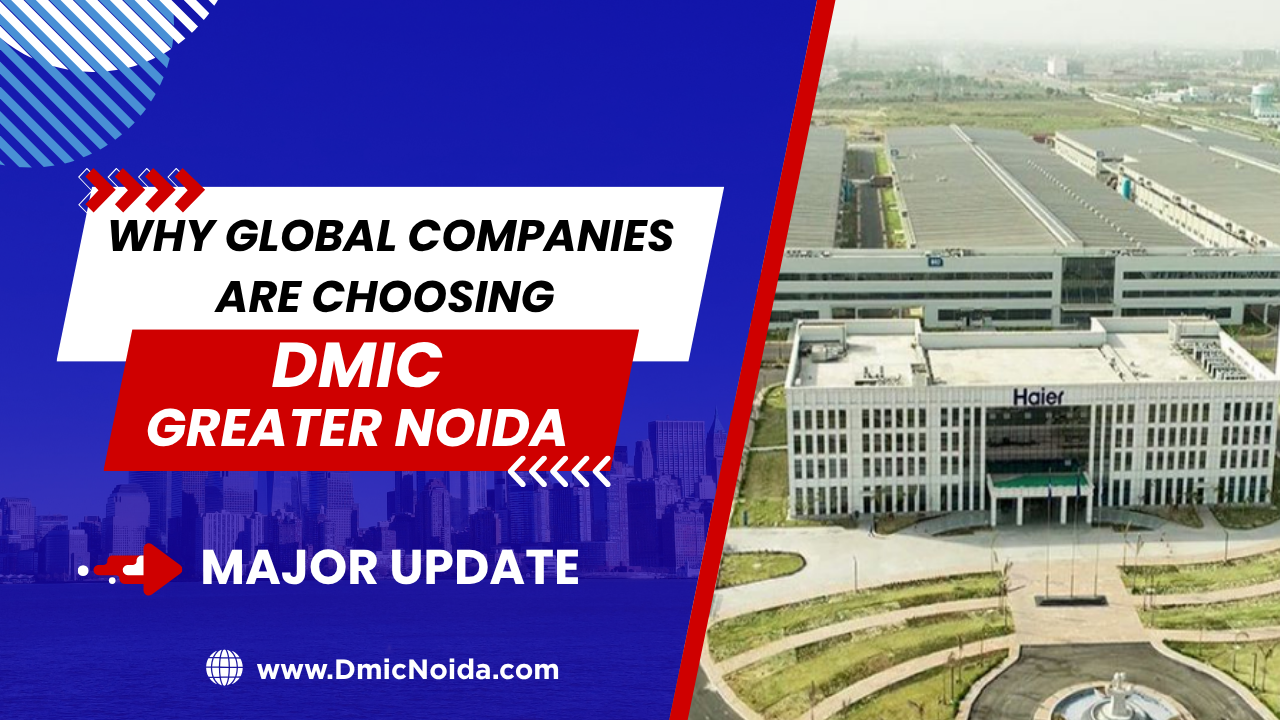
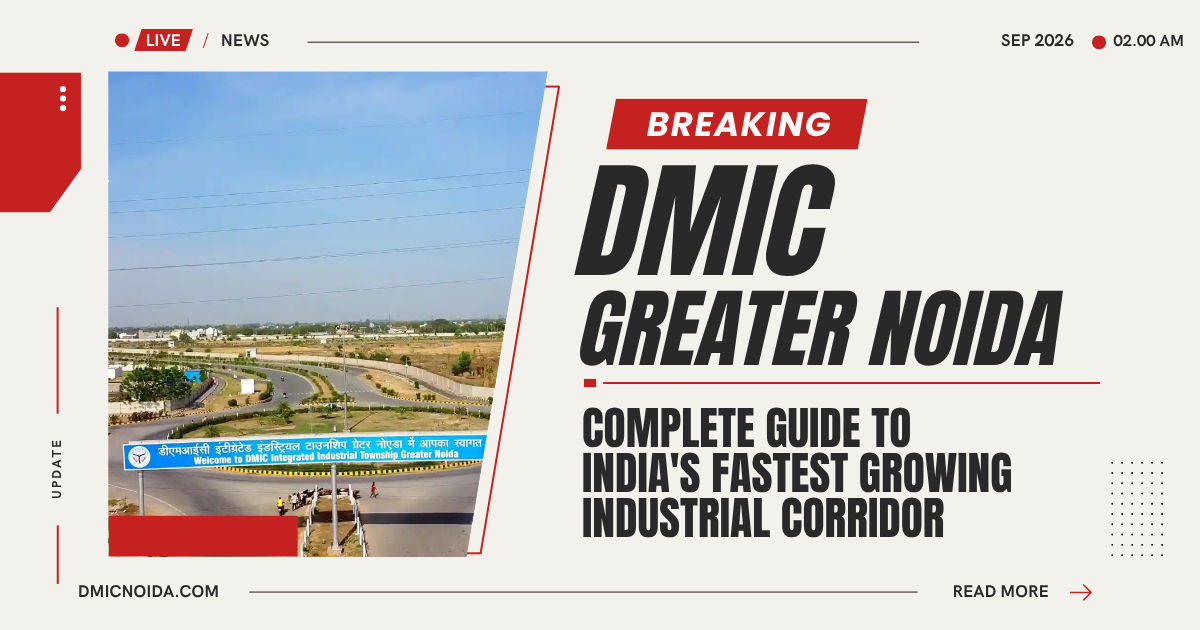
DMIC Greater Noida is emerging as one of the most strategically positioned development zones in the National Capital Region, supported by large-scale industrial, logistics, transportation and urban infrastructure projects.
At the centre of this transformation is the Delhi Mumbai Industrial Corridor (DMIC) and its Uttar Pradesh investment region known as the Dadri-Noida-Ghaziabad Investment Region (DNGIR).
The significance of DMIC Greater Noida goes beyond the development of individual industrial projects. The broader plan combines manufacturing, logistics, freight transportation, multimodal connectivity, commercial development, employment generation and planned urbanisation.
The DNGIR was identified as one of the investment regions in the first phase of DMIC. The proposed investment region covers approximately 200 sq km, with the Dadri-Khurja area strategically positioned around the Dedicated Freight Corridor network.
Greater Noida’s strategic advantage comes from its proximity to major expressways, railway infrastructure, the Eastern and Western Dedicated Freight Corridors, Noida, Delhi, Ghaziabad, the Yamuna Expressway corridor and the wider NCR market.
For businesses, manufacturers, logistics operators and investors, this combination can create a strong ecosystem for long-term economic activity.
Important: The phrase “India’s fastest growing industrial corridor” is commonly used as a marketing description. It should not be presented as an official government ranking. The stronger factual description is that Greater Noida is an important DMIC node with major industrial and logistics infrastructure planned and under development.
What is DMIC?
DMIC stands for Delhi Mumbai Industrial Corridor.
It is a major Government of India industrial infrastructure programme designed to strengthen manufacturing, logistics and economic activity between the National Capital Region and Mumbai.
The corridor is built around the Western Dedicated Freight Corridor (WDFC) and associated industrial regions, transport infrastructure, logistics facilities, expressways and planned industrial cities.
The broader objective is to create modern industrial cities and infrastructure capable of supporting manufacturing and services while improving logistics efficiency and connectivity.
According to the Government of India, the DMIC programme envisages greenfield industrial cities supported by reliable infrastructure, transportation systems, utilities and logistics facilities.
The DMIC is therefore not simply a road or railway project. It is a broader economic development programme involving:
- Industrial development
- Manufacturing
- Logistics
- Freight transportation
- Warehousing
- Export-oriented businesses
- Commercial development
- Skill development
- Urban infrastructure
- Employment generation
- Multimodal transportation
DMIC Greater Noida and DNGIR
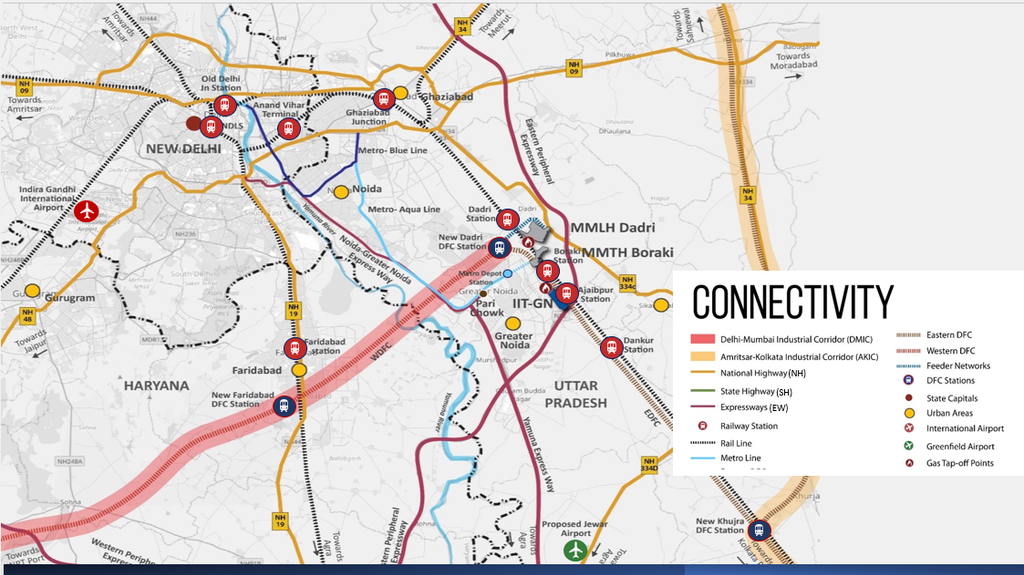
One of the most important components for Greater Noida is the Dadri-Noida-Ghaziabad Investment Region (DNGIR).
DNGIR was identified as one of the investment regions in the first phase of the DMIC programme.
The proposed investment region is approximately 200 sq km and is positioned between Dadri and Khurja along the freight corridor network. Its location is particularly important because the region connects with the Dedicated Freight Corridor system.
Why DNGIR is strategically important
The DNGIR is designed to support industrial development by bringing together:
- Manufacturing
- Logistics
- Freight movement
- Industrial land
- Supporting infrastructure
- Skilled employment
- Business services
- Technology
- Commercial activity
The location also provides access to the wider NCR market, giving businesses proximity to Delhi, Noida, Ghaziabad and other important economic centres.
Integrated Industrial Township Greater Noida
One of the major projects associated with DMIC Greater Noida is the Integrated Industrial Township (IIT).
Here, IIT refers to Integrated Industrial Township, not the Indian Institutes of Technology.
The Integrated Industrial Township has been developed under the DNGIR framework to facilitate large-scale industrial and commercial investment.
According to DMIC-IITGNL, the township site covers approximately 302.63 hectares and is located around 11 km by road from Pari Chowk, Greater Noida. It also benefits from proximity to the Delhi-Howrah railway line, Ajayabpur Railway Station and the Eastern Peripheral Expressway.
The township has been planned as a sustainable and smart industrial community with modern infrastructure.
Key objectives of the Integrated Industrial Township
The development is intended to:
- Attract industrial investment
- Support manufacturing businesses
- Create employment
- Improve industrial infrastructure
- Encourage technology-oriented businesses
- Develop supporting commercial activities
- Provide modern utilities
- Create an organised industrial ecosystem
The project was originally expected to generate significant private-sector investment over its development period. The Government of India had earlier estimated potential private-sector investment of more than ₹33,000 crore over 30 years for the Integrated Industrial Township project.
Multi Modal Logistics Hub – MMLH Greater Noida
Another major component of DMIC Greater Noida is the Multi Modal Logistics Hub (MMLH).
The MMLH is planned as a major logistics facility designed to connect different modes of freight transportation and improve the movement of industrial goods.
The strategic importance of the project comes from its proximity to the Dedicated Freight Corridor network.
According to DMIC-IITGNL, the proposed MMLH site is positioned close to the convergence of the Eastern and Western Dedicated Freight Corridors and covers approximately 293.8 hectares.
What will MMLH provide?
The logistics hub is designed to support:
- Container handling
- Freight storage
- Cargo aggregation
- Distribution
- Import and export logistics
- Value-added logistics services
- Freight company operations
- Industrial supply chains
- Connectivity with Dedicated Freight Corridors
The facility is envisioned as a one-stop destination for freight companies and customers.
This can be particularly important for export-oriented industries because efficient freight movement can reduce transportation time and improve supply-chain efficiency.
MMLH and Dedicated Freight Corridors
The Dedicated Freight Corridor network is one of the biggest reasons why the Greater Noida-Dadri region is strategically important.
The DNGIR is positioned close to the interface of major freight routes.
The Western Dedicated Freight Corridor terminates in the broader Dadri region, while the Eastern Dedicated Freight Corridor network also connects the area.
This gives the region a strategic advantage for industries that depend heavily on freight transportation.
Why freight connectivity matters
For manufacturers, logistics costs can have a significant impact on the final cost of goods.
A strong freight ecosystem can support:
- Faster movement of raw materials
- Faster movement of finished products
- Better warehouse utilisation
- Improved supply-chain planning
- Containerised transportation
- Export logistics
- Industrial distribution
This is one reason the Dadri-Greater Noida belt has attracted attention from industrial and logistics stakeholders.
Multi Modal Transport Hub – MMTH at Boraki
The Multi Modal Transport Hub (MMTH) at Boraki is another important DMIC-linked infrastructure project.
Unlike the MMLH, which focuses primarily on freight and logistics, the MMTH is designed around passenger transportation and multimodal connectivity.
According to DMIC-IITGNL, the Boraki MMTH is planned around the existing railway infrastructure and is intended to integrate multiple transportation modes.
The proposed components include:
- Railway terminal
- Interstate Bus Terminal
- Local transportation
- MRTS connectivity
- Commercial development
- Office space
- Shopping facilities
- Hotels
- Business centre
- Passenger facilities
The planned station-area development around Boraki covers approximately 412.7 acres according to DMIC-IITGNL.
Why Boraki is Important for Greater Noida
Boraki occupies an important location within the larger Greater Noida-Dadri development ecosystem.
A successful multimodal transportation hub can improve access between:
Greater Noida → Dadri → Ghaziabad → Delhi → NCR
It can also improve connectivity between residential areas, industrial zones, commercial centres and employment hubs.
The Government of India has described the MMTH at Boraki as a project intended to integrate rail, road and MRTS connectivity, along with facilities such as bus terminals and commercial development.
Connectivity Advantages of DMIC Greater Noida
Connectivity is one of the biggest advantages of the DMIC Greater Noida region.
The area benefits from access to multiple road, rail and freight corridors.
1. Eastern Dedicated Freight Corridor
The Eastern Dedicated Freight Corridor is an important freight infrastructure component connected with the DNGIR region.
It strengthens the area’s potential as a logistics and industrial location.
2. Western Dedicated Freight Corridor
The Western Dedicated Freight Corridor is particularly important for the Dadri region because the corridor’s network provides a strategic freight connection toward western India and ports.
3. Eastern Peripheral Expressway
The Eastern Peripheral Expressway provides an important orbital connection around Delhi and connects the region with several major highways and economic zones.
The Integrated Industrial Township site directly benefits from its proximity to the Eastern Peripheral Expressway.
4. Yamuna Expressway
The Yamuna Expressway connects Greater Noida with the Yamuna Expressway industrial belt and Agra.
This creates an important north-south development axis for the region.
5. Noida-Greater Noida Expressway
The Noida-Greater Noida Expressway provides direct connectivity between Noida and Greater Noida and supports movement between residential, commercial and employment centres.
6. NH-91 / GT Road Connectivity
The Dadri region also benefits from connectivity with the wider highway network, including the NH-91 corridor.
The Government of India specifically highlights the proximity of the Greater Noida MMLH and MMTH projects to the Eastern Peripheral Expressway, NH-91, Noida-Greater Noida Expressway, Yamuna Expressway and the Eastern and Western Dedicated Freight Corridors.
Delhi and NCR Connectivity
Another major advantage of DMIC Greater Noida is its location within the National Capital Region.
Greater Noida is connected to important economic centres including:
- Delhi
- Noida
- Ghaziabad
- Dadri
- Faridabad
- Gurugram
- Meerut
- Greater Noida
- Yamuna Expressway region
This creates access to a large consumer market and a substantial employment base.
For businesses, proximity to NCR can help with:
- Talent availability
- Customer access
- Supplier networks
- Corporate offices
- Warehousing
- Distribution
- Business services
Greater Noida Airport and the Wider Investment Ecosystem
The development of the Noida International Airport at Jewar adds another important layer to the broader economic potential of the region.
The airport is part of the wider Yamuna Expressway development ecosystem and is expected to strengthen air connectivity for the region.
When considered alongside:
- DMIC
- DNGIR
- Dedicated Freight Corridors
- Yamuna Expressway
- Eastern Peripheral Expressway
- Noida-Greater Noida Expressway
- MMLH
- MMTH
- Industrial townships
the region has the potential to develop into a large integrated industrial, logistics and urban growth corridor.
However, investors should evaluate individual projects based on their actual location and confirmed infrastructure rather than assuming that every property in Greater Noida will automatically benefit equally from all DMIC projects.
Why Industries May Choose DMIC Greater Noida
Industrial investors typically consider several factors before selecting a location.
DMIC Greater Noida offers a combination of strategic advantages.
1. Strategic NCR Location
The region provides access to the large Delhi-NCR market.
2. Freight Connectivity
The proximity of the Dedicated Freight Corridor network supports freight-intensive industries.
3. Expressway Network
Multiple expressways provide road connectivity to important markets and industrial clusters.
4. Logistics Infrastructure
The proposed MMLH can strengthen the area’s logistics ecosystem.
5. Multimodal Passenger Connectivity
The proposed Boraki MMTH can improve passenger movement and accessibility.
6. Industrial Infrastructure
The Integrated Industrial Township provides planned industrial infrastructure.
7. Large Employment Base
Industrial and logistics development can create direct and indirect employment, supporting demand for residential and commercial services.
Industries That Can Benefit From DMIC Greater Noida
DMIC Greater Noida can support multiple industrial and service sectors.
These may include:
- Manufacturing
- Auto components
- Electronics
- Engineering
- Defence manufacturing
- IT and IT-enabled services
- Research and development
- Food processing
- Agro-based industries
- Warehousing
- Logistics
- E-commerce supply chains
- Export-oriented manufacturing
- Packaging
- Distribution
- Commercial services
Government documentation on DMIC investment regions has identified sectors including general manufacturing, automotive and auto components, defence manufacturing, R&D, IT/ITES, high-tech industries, agro and food processing.
Employment Potential Around DMIC Greater Noida
Industrial development normally produces employment beyond factory jobs.
A mature industrial ecosystem can create demand for:
- Engineers
- Technicians
- Factory workers
- Logistics professionals
- Warehouse operators
- Drivers
- Managers
- Administrative staff
- IT professionals
- Security services
- Maintenance professionals
- Retail workers
- Hospitality professionals
- Healthcare services
- Education services
The Government of India has previously estimated significant employment potential from the Greater Noida MMLH and MMTH projects, with around 1 lakh employment opportunities by 2040 associated with both projects in its project assessment. This is a government estimate rather than a guaranteed employment figure.
Impact on Residential Development
Large industrial and logistics projects can generate secondary demand for housing.
When companies establish operations, employees and supporting businesses require:
- Apartments
- Plotted developments
- Rental housing
- Serviced apartments
- Hostels
- Retail shops
- Schools
- Healthcare
- Restaurants
- Entertainment
- Daily-needs markets
This can create a broader urban ecosystem around employment centres.
For real estate investors, the important factor is therefore not simply the announcement of an industrial project, but the relationship between:
Industrial development + employment + transportation + residential demand + commercial infrastructure.
Commercial Real Estate Opportunities
DMIC Greater Noida may also create opportunities for commercial real estate.
Potential segments include:
Retail
Growing residential and employment populations can support neighbourhood retail.
Office Space
Industrial companies and supporting businesses require offices and business centres.
Warehousing
The logistics ecosystem can increase demand for modern warehouses and distribution centres.
Hospitality
Hotels and serviced accommodation can benefit from business travel and industrial activity.
Restaurants
Growing employment zones can support food and hospitality businesses.
Business Services
Accounting, logistics, consulting, recruitment, technology and professional services can develop around industrial clusters.
Investment Opportunities Around DMIC Greater Noida
DMIC Greater Noida can be viewed as a long-term infrastructure-led development story, but investors should distinguish between different investment categories.
1. Industrial Land
Industrial land can be relevant for companies planning manufacturing or logistics operations.
The investment case depends heavily on:
- Land-use approval
- Authority jurisdiction
- Infrastructure availability
- Road connectivity
- Industrial policy
- Plot size
- Development timeline
2. Warehousing
The growth of logistics infrastructure can increase demand for strategically located warehouses.
The most attractive locations are generally those with strong access to highways, freight corridors and industrial clusters.
3. Residential Property
Residential investment may benefit where industrial employment and infrastructure generate genuine end-user demand.
Investors should prioritise locations with:
- Existing habitation
- Schools
- Hospitals
- Retail
- Public transportation
- Employment accessibility
- Clear legal title
- Appropriate approvals
4. Commercial Property
Commercial property can benefit from increasing business activity, but location selection remains critical.
A property located close to a confirmed employment cluster can have a different risk profile from a property relying solely on future announcements.
5. Rental Property
Rental demand can emerge around industrial and logistics employment centres.
However, rental investment should be evaluated using actual occupancy, existing rental demand and local employment rather than projected appreciation alone.
Why Investors Are Watching Dadri and Boraki
The Dadri-Boraki belt has strategic importance because multiple infrastructure systems intersect in the broader region.
These include:
Dedicated Freight Corridors + Railway + Expressways + Industrial Infrastructure + Logistics + Multimodal Transportation
This creates the possibility of a highly connected economic zone.
The MMLH is planned around freight movement, while the MMTH at Boraki is planned around passenger movement.
Together, these projects can strengthen the region’s industrial and urban ecosystem.
Future Growth Potential of DMIC Greater Noida
The future growth story of DMIC Greater Noida is linked to the gradual development of multiple infrastructure layers.
Phase 1: Infrastructure Development
Industrial infrastructure, roads, utilities and transportation connectivity establish the foundation.
Phase 2: Industrial Investment
Manufacturing, logistics and other businesses begin establishing operations.
Phase 3: Employment Creation
Industrial activity creates direct and indirect employment.
Phase 4: Residential Demand
Workers and professionals generate demand for housing.
Phase 5: Commercial Development
Retail, offices, hospitality, education and healthcare develop around growing populations.
Phase 6: Integrated Urban Growth
Over time, industrial, residential, commercial and transportation infrastructure can form a more integrated economic region.
This is why infrastructure-led development can have a multiplier effect beyond the original project.
Latest MMLH Development Direction
The MMLH project is particularly important to monitor because it has moved beyond being only a conceptual infrastructure proposal.
DMIC-IITGNL has published a Request for Qualification/Request for Proposal for development of a Greenfield Multi Modal Logistics Hub at Greater Noida on a DBFOT basis. The tender information published by IITGNL shows the project being taken forward through a formal development process.
The Government’s public-private infrastructure process has also considered the development of the Greater Noida MMLH.
This makes the logistics component particularly relevant when evaluating the long-term industrial potential of the Dadri-Greater Noida region.
DMIC Greater Noida vs Traditional Real Estate Development
The biggest difference between infrastructure-led development and conventional real estate growth is the economic engine behind the location.
A conventional residential market may depend primarily on:
- Population growth
- Local employment
- Developer activity
- Connectivity
An industrial corridor can add another layer:
Manufacturing + Logistics + Freight + Employment + Infrastructure + Residential + Commercial
This can create a broader economic ecosystem.
However, this does not mean every property located within Greater Noida will automatically appreciate at the same rate.
Property-specific factors remain extremely important.
Factors to Check Before Investing
Investors considering DMIC Greater Noida should conduct due diligence before purchasing any property.
Check the Authority
Identify whether the property falls under:
- GNIDA
- YEIDA
- GDA
- Another development authority
Check Land Use
Verify whether the land is:
- Residential
- Commercial
- Industrial
- Institutional
- Agricultural
- Mixed-use
Check Approvals
Check:
- RERA registration where applicable
- Building approvals
- Layout approvals
- Land title
- Development authority approvals
- Completion/occupancy status where applicable
Check Actual Connectivity
Do not rely only on marketing maps.
Check the actual road distance to:
- Expressways
- Railway stations
- Industrial areas
- Employment centres
- Airports
- Commercial areas
Check Development Status
Separate:
Operational
from
Under Construction
and
Proposed
and
Conceptual/Long-Term
This distinction is extremely important when making an investment decision.
DMIC Greater Noida Location Advantages
The biggest location advantages can be summarised as follows:
Strategic NCR Position
Close to major economic centres of Delhi-NCR.
Dedicated Freight Corridor Access
Strong strategic positioning around India’s major freight infrastructure.
Expressway Connectivity
Access to multiple major expressways.
Industrial Ecosystem
Presence of planned industrial development and the Integrated Industrial Township.
Logistics Potential
MMLH development can strengthen the regional logistics ecosystem.
Multimodal Transportation
MMTH at Boraki is planned to integrate rail, road and mass rapid transit.
Employment Potential
Industrial and logistics expansion can create employment.
Residential Demand
Employment growth can support housing demand in surrounding areas.
Commercial Potential
Growing industrial and residential populations can create demand for retail, offices and services.
Key DMIC Greater Noida Projects at a Glance
| Project | Location | Primary Purpose |
|---|---|---|
| DNGIR | Dadri-Noida-Ghaziabad region | Industrial & economic development |
| Integrated Industrial Township | Greater Noida | Manufacturing & industrial development |
| MMLH | Dadri/Greater Noida region | Freight & logistics |
| MMTH | Boraki | Passenger & multimodal transport |
| Dedicated Freight Corridors | Dadri/NCR region | High-capacity freight movement |
| Eastern Peripheral Expressway | Greater Noida region | Regional road connectivity |
| Yamuna Expressway | Greater Noida-Yamuna corridor | Regional connectivity |
| Noida-Greater Noida Expressway | Noida-Greater Noida | Urban connectivity |
DMIC Greater Noida: Long-Term Outlook
The long-term potential of DMIC Greater Noida comes from the combination of infrastructure rather than a single project.
The region is positioned at the intersection of several important economic networks.
Industrial Development
↓
Dedicated Freight Corridors
↓
Logistics Infrastructure
↓
Expressway Connectivity
↓
Employment Generation
↓
Residential Demand
↓
Commercial Development
↓
Urban Growth
This type of interconnected development can create a self-reinforcing economic ecosystem.
The key is execution. Infrastructure announcements alone do not create immediate investment returns. Actual construction, industrial occupancy, employment generation, connectivity improvements and population growth are the factors that ultimately determine how an area performs.
Is DMIC Greater Noida Good for Investment?
DMIC Greater Noida can be attractive for investors who are looking at long-term infrastructure-led growth, particularly in areas connected to established or progressing industrial, logistics and transportation infrastructure.
Potential investment themes include:
- Industrial land
- Warehousing
- Logistics
- Commercial property
- Residential property
- Rental housing
- Industrial support services
However, investors should not buy solely because a property is advertised as “DMIC connected.”
The actual investment decision should consider:
Location + Authority + Land Use + Approvals + Connectivity + Development Status + End-User Demand + Pricing + Holding Period
A property with strong fundamentals and existing connectivity may be less risky than a property that depends entirely on future infrastructure.
Frequently Asked Questions About DMIC Greater Noida
What is DMIC Greater Noida?
DMIC Greater Noida refers to the Greater Noida and surrounding region’s role within the Delhi Mumbai Industrial Corridor, particularly through the Dadri-Noida-Ghaziabad Investment Region.
What is DNGIR?
DNGIR stands for Dadri-Noida-Ghaziabad Investment Region. It is one of the investment regions identified under the first phase of DMIC and is planned as a major industrial and economic development zone.
What is IIT Greater Noida?
In the context of DMIC, IIT refers to the Integrated Industrial Township, not the Indian Institute of Technology. The township has been developed under the DNGIR framework to support industrial and commercial investment.
What is MMLH Greater Noida?
MMLH stands for Multi Modal Logistics Hub. It is planned as a major logistics facility intended to facilitate storage, freight movement, container handling and value-added logistics services.
What is MMTH Greater Noida?
MMTH stands for Multi Modal Transport Hub. The Boraki project is planned to integrate railway, road, MRTS and bus transportation with commercial and passenger facilities.
Where is the MMTH located?
The proposed MMTH is located at Boraki in Greater Noida, around the existing railway infrastructure.
Why is Dadri important for DMIC?
Dadri is strategically important because of its position within the DNGIR and its relationship with the Dedicated Freight Corridor network.
Why is Greater Noida important for industrial investment?
Greater Noida combines NCR market access with expressway connectivity, industrial infrastructure, logistics development and proximity to major freight transportation networks.
Is DMIC Greater Noida a good property investment?
It can offer long-term investment potential, but property should be evaluated individually based on its exact location, approvals, authority, land use, connectivity, pricing and actual development status.
Will DMIC increase property prices in Greater Noida?
Infrastructure and employment growth can contribute to real estate demand, but appreciation is not guaranteed. Actual market performance depends on supply, demand, infrastructure execution, employment growth and property-specific fundamentals.
DMIC Greater Noida is more than an industrial corridor. It represents a broader economic development ecosystem built around manufacturing, logistics, freight transportation, multimodal connectivity and planned urban growth.
The DNGIR, Integrated Industrial Township, Multi Modal Logistics Hub at Dadri, Multi Modal Transport Hub at Boraki and the surrounding Dedicated Freight Corridor and expressway network collectively give the region strategic importance.
For businesses, the major attraction is connectivity to industrial and consumer markets.
For manufacturers, the combination of industrial infrastructure and freight connectivity can support supply-chain efficiency.
For logistics companies, the MMLH and freight corridor ecosystem can create new opportunities.
For residential and commercial real estate, the long-term opportunity is linked to employment generation, population growth and supporting infrastructure.
The most important takeaway for investors is simple:
Do not invest only in the DMIC story. Invest after evaluating the exact location, infrastructure status, approvals, authority, land use, pricing and real demand.
As the industrial and logistics ecosystem develops, the Dadri-Greater Noida-Boraki belt is likely to remain an important area to watch within the NCR’s long-term economic growth story.
buying property DMIC Greater Noida Dadri DFC Dadri logistics hub Dadri MMLH DMIC 2030 DMIC companies in Greater Noida DMIC connectivity DMIC corridor investment DMIC electronics industry DMIC employment opportunities DMIC Greater Noida DMIC Greater Noida 2030 DMIC Greater Noida 2040 DMIC Greater Noida airport DMIC Greater Noida apartments DMIC Greater Noida companies DMIC Greater Noida connectivity DMIC Greater Noida development DMIC Greater Noida industries DMIC Greater Noida investment DMIC Greater Noida jobs DMIC Greater Noida logistics DMIC Greater Noida property DMIC Greater Noida residential demand DMIC Integrated Township DMIC real estate investment Godrej DMIC Greater Noida Godrej Global Business City Godrej Properties Greater Noida Godrej residential development Greater Noida industrial corridor Greater Noida industrial development Greater Noida industrial investment Greater Noida logistics hub Greater Noida logistics infrastructure Greater Noida manufacturing hub Greater Noida warehousing Hero Homes DMIC Contact Number Hero Homes DMIC Floor Plans Hero Homes DMIC Master Plans Hero Homes DMIC Payment Plan Integrated Industrial Township Greater Noida logistics companies Greater Noida manufacturing Greater Noida MMLH Greater Noida