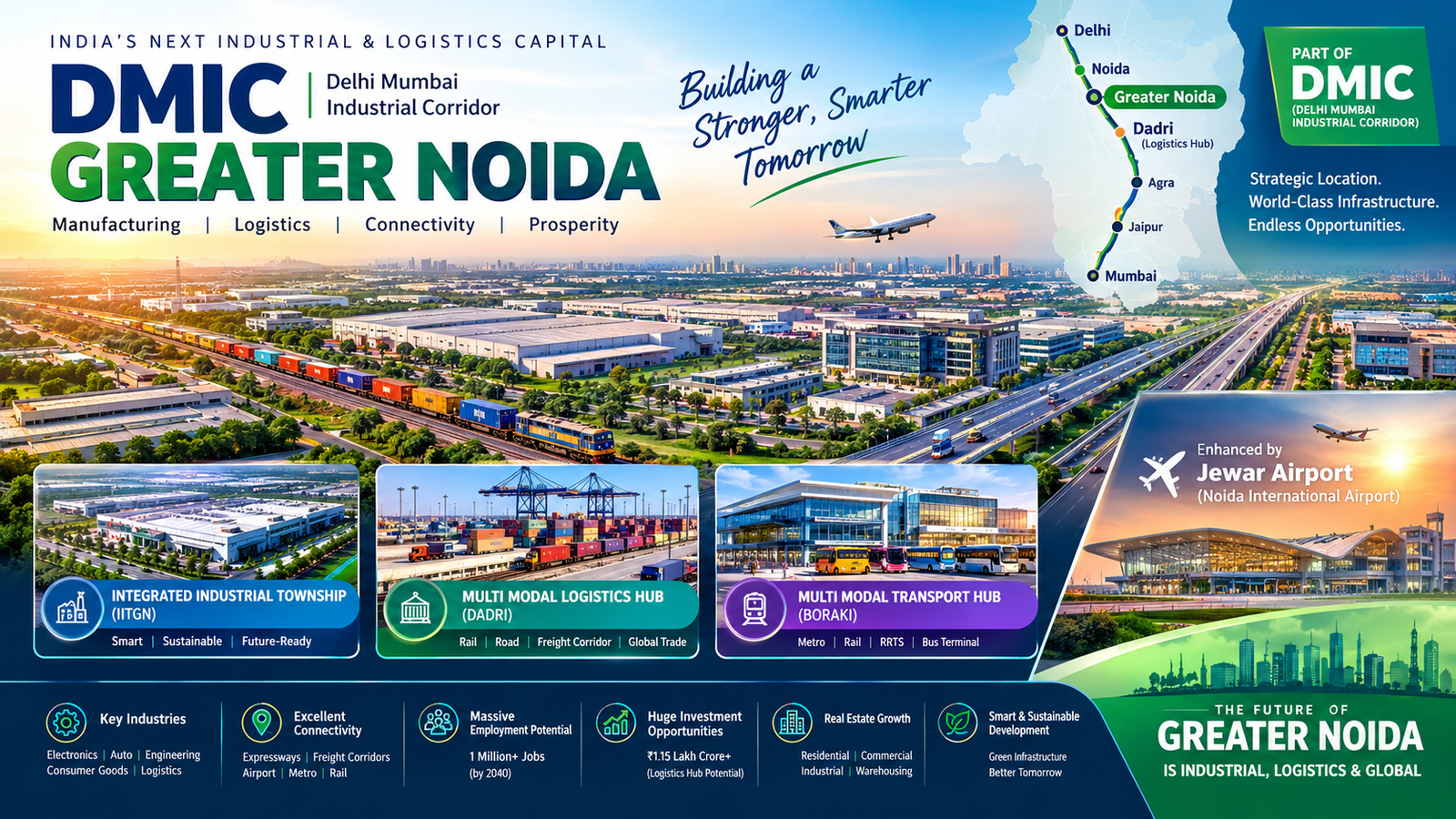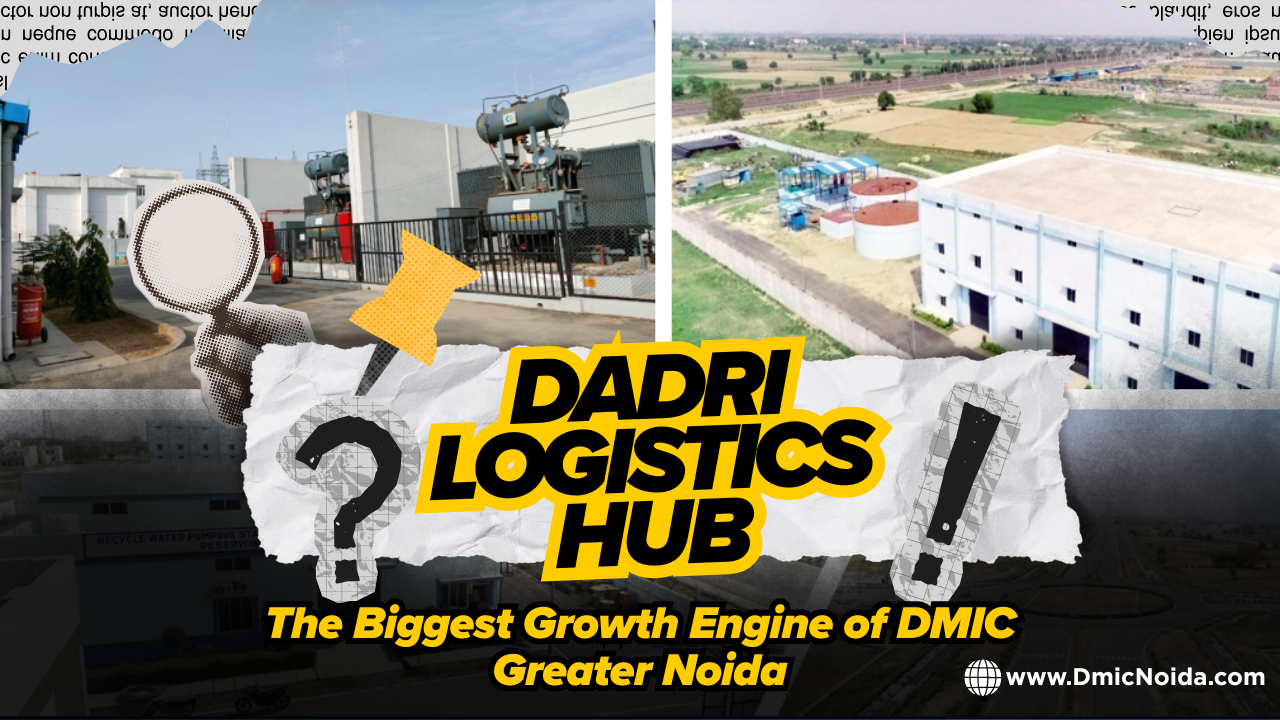
Explore the Dadri Multi-Modal Logistics Hub, including MMLH, warehousing, container terminals, dry port potential, DFC connectivity and its role in DMIC Greater Noida.
When discussing the future of DMIC Greater Noida, much of the attention naturally goes towards manufacturing, industrial parks and large corporate investments.
However, one of the most important pieces of the region’s long-term industrial strategy is the development of logistics infrastructure around Dadri.
The planned Multi-Modal Logistics Hub (MMLH) near Dadri is designed to bring together freight movement, logistics services, warehousing and multimodal connectivity.
Its strategic importance comes from its location near the convergence of the Eastern and Western Dedicated Freight Corridors, along with connectivity to major expressways and highways.
The Government of India has described the Greater Noida MMLH and MMTH projects as being close to the Eastern Peripheral Expressway, NH-91, Noida-Greater Noida Expressway, Yamuna Expressway and the Eastern and Western Dedicated Freight Corridors.
This makes Dadri a potentially important logistics gateway for northern India’s manufacturing and distribution networks.
What Is the Dadri Multi-Modal Logistics Hub?
The Multi-Modal Logistics Hub (MMLH) is planned near Dadri within the wider Dadri-Noida-Ghaziabad Investment Region.
The objective is to create a large-scale logistics facility where different transportation and logistics activities can operate together.
The original government planning documentation identified approximately 438.9 hectares for the MMLH, including approximately 293.8 hectares for Phase I.
The project is intended to support:
- Freight handling
- Warehousing
- Container movement
- Storage
- Cargo aggregation
- Distribution
- Value-added logistics services
- Multimodal transportation
Instead of goods moving through disconnected logistics facilities, the MMLH concept is designed around integration.
1. Why Dadri Is Strategically Important
Dadri occupies an unusually important position within the northern Indian freight network.
The region is close to the point where the Eastern and Western Dedicated Freight Corridors meet.
This is one of the biggest reasons why Dadri has strategic importance within DMIC.
Government documentation has specifically highlighted the MMLH’s proximity to the convergence of the Eastern and Western DFCs.
This means Dadri can potentially function as a gateway between:
Eastern India
↕
Northern India
↕
Western India
For manufacturers, distributors and logistics companies, such connectivity can reduce the need for freight to pass through multiple disconnected transportation networks.
2. The Multi-Modal Concept
The word “multi-modal” is central to understanding the project.
A modern logistics hub does not rely exclusively on one transportation mode.
Instead, it connects different modes.
Road
For first-mile and last-mile movement.
Rail
For high-volume and long-distance freight.
Dedicated Freight Corridors
For faster and more efficient freight railway connectivity.
Warehousing
For storage and inventory management.
Container Handling
For domestic and international cargo.
This creates a connected logistics chain.
A typical movement could look like:
Factory
↓
Truck
↓
Dadri Logistics Hub
↓
Container / Rail
↓
Dedicated Freight Corridor
↓
Western or Eastern Freight Network
↓
Port / Distribution Centre
This is the fundamental idea behind a multimodal logistics hub.
3. Warehousing: A Major Opportunity Around Dadri
Large manufacturing clusters require large amounts of warehouse space.
Manufacturers need warehouses for:
- Raw materials
- Components
- Finished products
- Packaging materials
- Spare parts
- Export cargo
- Distribution inventory
As industrial activity increases in Greater Noida, demand for logistics and warehousing facilities can also increase.
Dadri’s location gives it potential to become a major warehousing and distribution zone serving the wider NCR and northern India.
4. Industrial Warehousing and Manufacturing Can Work Together
The relationship between manufacturing and logistics is extremely important.
Consider an electronics manufacturer.
Components may arrive from different suppliers.
They are brought to a warehouse.
They are delivered to the factory.
Finished products return to a distribution warehouse.
From there, products are transported to markets across India or towards export gateways.
A logistics hub located close to manufacturing facilities can potentially simplify this process.
This is why Dadri’s logistics development is important for the wider Greater Noida industrial ecosystem.
5. Container Terminals
Containerisation is one of the foundations of modern international trade.
Containers allow cargo to move between different transportation modes without repeatedly handling individual goods.
A container can move through:
Factory → Truck → Rail → Port → Ship
without the cargo itself being unloaded at every transportation stage.
This reduces handling requirements and can improve supply-chain efficiency.
The Dadri logistics ecosystem is strategically positioned to support containerised freight because of its relationship with the Dedicated Freight Corridor network.
6. Dadri as an Inland Logistics Gateway
Dadri does not have a seaport.
So why is it important for international logistics?
Because modern supply chains do not require every logistics facility to be located at a port.
An inland logistics hub can act as an interface between factories and ports.
This is where the dry port concept becomes relevant.
7. What Is a Dry Port?
A dry port is an inland logistics facility that performs some functions normally associated with seaports.
Depending on the facility and its approvals, these can include:
- Container handling
- Cargo consolidation
- Warehousing
- Customs-related processes
- Documentation
- Rail connectivity
- Road connectivity
- Distribution
Instead of sending every container directly by road to a seaport, cargo can be consolidated and transported through an inland logistics network.
This can potentially reduce unnecessary road movements and improve cargo organisation.
8. Dadri’s Dry Port Potential
Dadri’s strategic location makes it suitable for a dry-port-style logistics ecosystem.
It is positioned within the northern Indian industrial market and close to major freight infrastructure.
The original DMIC planning documents described the proposed logistics hub as being strategically located close to the convergence of the Eastern and Western DFCs.
The 2020 Cabinet approval described the Greater Noida logistics hub as a planned world-class facility for efficient storage and transition of goods to and from the Dedicated Freight Corridors, providing a one-stop destination for freight companies and customers.
This is essentially the logic behind an inland freight gateway.
9. Containerisation Can Support Export Growth
For export-oriented manufacturers, containers are critical.
A factory may produce thousands of products every day, but those products eventually need to move through an organised export supply chain.
The logistics process can include:
Manufacturing
↓
Quality Inspection
↓
Packaging
↓
Warehouse
↓
Containerisation
↓
Rail / Road Freight
↓
Port
↓
International Market
A well-developed inland logistics hub can become an important intermediate point within this chain.
10. Connectivity With the Eastern and Western DFC
The DFC connection is arguably the biggest strategic advantage of Dadri.
The Western Dedicated Freight Corridor connects the northern industrial region towards western India and the country’s major port network.
The Eastern DFC provides connectivity towards eastern freight markets.
Dadri’s location near the convergence of these freight networks gives the region a unique position.
This can allow businesses to think beyond the NCR market.
A manufacturer in Greater Noida can potentially serve:
- Delhi-NCR
- Uttar Pradesh
- Haryana
- Rajasthan
- Punjab
- Eastern India
- Western India
- Export markets
through interconnected road and freight networks.
11. Road Connectivity Around Dadri
Rail is only one part of the logistics equation.
The first and last stages of transportation still require roads.
The Greater Noida logistics hub is strategically connected with major roads and expressways.
Government documents identify proximity to:
- Eastern Peripheral Expressway
- NH-91
- Noida-Greater Noida Expressway
- Yamuna Expressway
- Eastern DFC
- Western DFC
as important advantages of the Greater Noida logistics hub.
This combination of road and rail connectivity is what makes the region suitable for multimodal logistics.
12. Warehousing Opportunities Around the Logistics Hub
The development of a major logistics hub can create demand for multiple warehouse categories.
General Warehousing
For consumer products and industrial goods.
Industrial Warehousing
For components and manufacturing inputs.
Distribution Centres
For regional distribution.
E-Commerce Fulfilment
For online retail inventory.
Cold Storage
For temperature-sensitive products.
Export Warehousing
For products awaiting international shipment.
Bonded / Customs-Linked Facilities
Subject to applicable approvals and regulations.
The exact mix will depend on how the logistics ecosystem develops and what facilities are ultimately approved and operational.
13. Value-Added Logistics Services
A modern logistics hub is not simply a place where trucks park.
It can support several value-added activities.
These can include:
- Packaging
- Labelling
- Sorting
- Consolidation
- Deconsolidation
- Inventory management
- Container handling
- Freight forwarding
- Distribution
- Cold-chain services
- Light processing
These activities can generate additional employment and business opportunities.
14. Why MMLH Matters to Manufacturers
For a manufacturing company, logistics can represent a significant part of the overall supply chain.
The MMLH concept can potentially provide manufacturers with a central location for:
Inbound Logistics
Raw materials and components.
Storage
Inventory management.
Outbound Logistics
Finished-product distribution.
Export Logistics
Container movement towards ports.
This can make logistics planning more efficient.
15. MMLH and the Greater Noida Industrial Ecosystem
The logistics hub becomes even more important when considered alongside the region’s manufacturing infrastructure.
Greater Noida is developing an industrial ecosystem containing:
- Integrated Industrial Township
- DNGIR
- MMLH
- MMTH Boraki
- Industrial plots
- Warehousing
- Manufacturing facilities
- Road infrastructure
- Freight infrastructure
The MMLH therefore acts as a supporting component of the wider industrial ecosystem.
Manufacturing creates cargo.
Logistics infrastructure moves that cargo.
This creates a natural relationship between the two.
16. MMLH and Employment Opportunities
Logistics hubs can generate employment across a wide range of activities.
These include:
Direct Employment
- Warehouse operators
- Logistics managers
- Freight planners
- Equipment operators
- Container handlers
- Administrative staff
- Maintenance workers
Indirect Employment
- Truck drivers
- Transport companies
- Packaging suppliers
- Repair services
- Security services
- Facility management
- Freight forwarding
- Food and retail services
Earlier government planning for the Greater Noida logistics hub highlighted employment and wider supply-chain benefits associated with the project.
Actual employment will depend on the final development model, investment and operational scale.
17. Dadri Could Become a Major Distribution Gateway
The location of Dadri makes it particularly suitable for regional distribution.
A company can potentially locate a distribution centre near the logistics hub and serve northern India.
For example:
Dadri
↓
Delhi-NCR
↓
Western Uttar Pradesh
↓
Haryana
↓
Rajasthan
↓
Punjab
This could reduce the need for companies to maintain separate large warehouses in every individual market.
18. Why E-Commerce Could Benefit
The growth of e-commerce has increased the importance of strategically located fulfilment centres.
E-commerce businesses require:
- Large warehouses
- Fast inventory movement
- Sorting facilities
- Transportation
- Last-mile distribution
- Returns management
Greater Noida’s proximity to the NCR consumer market gives logistics operators access to a large potential demand base.
A large logistics ecosystem around Dadri could therefore serve both traditional manufacturing and newer digital-commerce supply chains.
19. Dadri’s Role in India’s Export Supply Chain
The significance of the logistics hub extends beyond domestic distribution.
India’s manufacturing ambitions increasingly depend on exports.
Manufacturers need efficient connections between factories and ports.
Dadri can potentially serve as an inland aggregation point where export cargo is:
Collected
↓
Stored
↓
Consolidated
↓
Containerised
↓
Moved by Road/Rail
↓
Transferred to Port Network
This is where the dry-port concept becomes strategically relevant.
20. Logistics Infrastructure Can Reduce Multiple Handling
One of the major objectives of multimodal logistics infrastructure is to reduce unnecessary handling.
Without integrated logistics, cargo may move through several separate facilities:
Factory → Local Warehouse → Truck Terminal → Another Warehouse → Rail Terminal → Port
Every additional transfer can create:
- Time
- Cost
- Handling
- Inventory complexity
- Risk of damage
A properly integrated logistics hub aims to consolidate several functions.
The Government of India’s broader multimodal logistics programme similarly focuses on cargo aggregation and distribution hubs connected to industrial nodes, consumer centres and EXIM gateways.
21. Current Development Context
The Dadri MMLH is part of India’s National Industrial Corridor Development framework.
Government information released in 2026 lists the Multi-Modal Logistics Hub at Dadri and Multi-Modal Transport Hub at Boraki among the Uttar Pradesh projects under the industrial corridor programme, with a combined project cost listed at approximately ₹3,907 crore in the relevant funding statement.
This is important because it demonstrates that the logistics project remains part of the active national industrial-corridor development programme.
However, individual components, construction schedules and operational timelines can change as procurement and implementation progress.
22. Dadri Logistics Hub and the Future of DMIC Greater Noida
The long-term significance of Dadri comes from the interaction between logistics and manufacturing.
Consider the wider ecosystem:
IITGN
Provides industrial infrastructure.
DNGIR
Provides a larger planned industrial investment region.
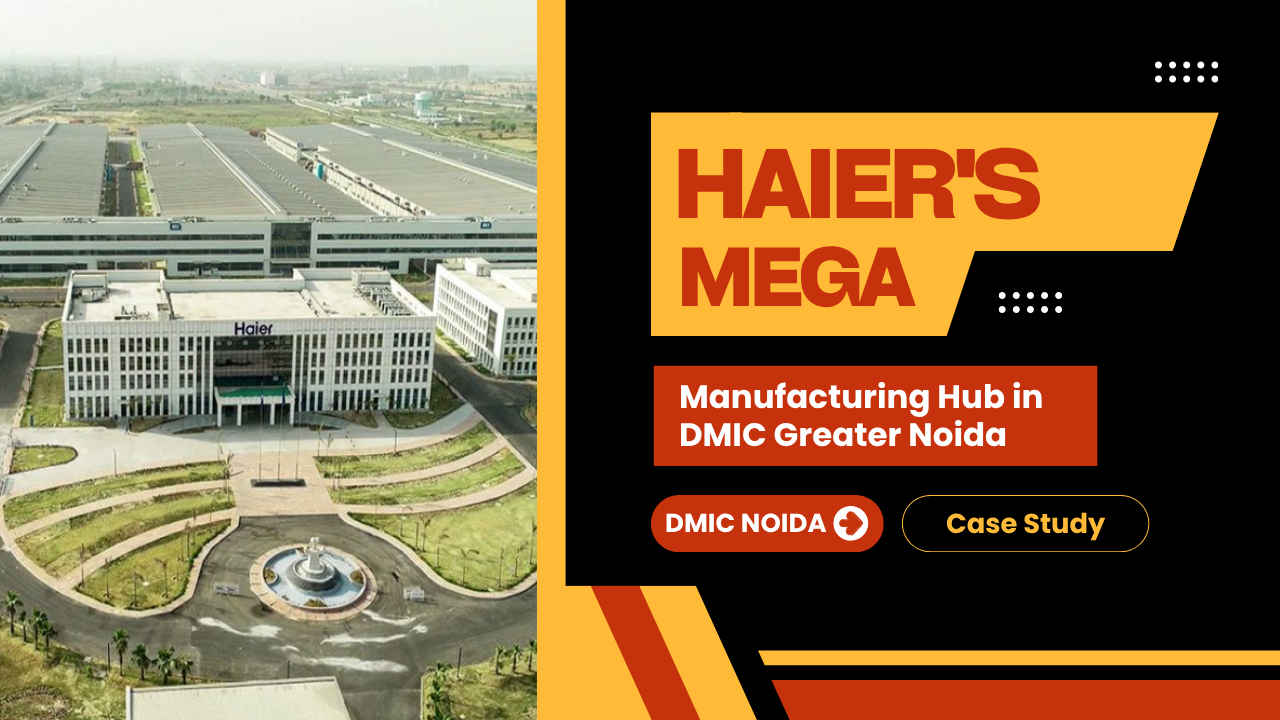
Haier and Other Manufacturers
Create industrial cargo.
MMLH
Handles and consolidates freight.
DFC
Moves freight over longer distances.
MMTH Boraki
Supports multimodal passenger and commercial connectivity.
Together, these components can create a much more integrated industrial region.
23. Why Dadri Could Become One of North India’s Important Logistics Locations
The strongest argument for Dadri is its network position.
It combines:
DFC
Expressways
Industrial Manufacturing
NCR Market
Warehousing
Multimodal Logistics
Export Connectivity
This combination gives Dadri the potential to become an important freight and distribution gateway.
The final scale of this opportunity will depend on infrastructure execution, private investment, industrial demand and the operationalisation of planned facilities.
Conclusion: Dadri Logistics Hub Could Become the Backbone of DMIC Greater Noida
The Dadri Multi-Modal Logistics Hub is one of the most strategically important components of the Greater Noida DMIC ecosystem.
Its importance comes from its location near the convergence of the Eastern and Western Dedicated Freight Corridors and its connectivity to major road corridors.
The MMLH can potentially support:
- Warehousing
- Container movement
- Freight aggregation
- Distribution
- Export logistics
- Value-added logistics services
- Multimodal transportation
The dry-port concept adds another important dimension by allowing an inland location such as Dadri to function as a logistics gateway between manufacturing centres and India’s wider port network.
As manufacturing activity expands in Greater Noida, logistics infrastructure will become increasingly important.
Factories produce goods.
Warehouses store them.
Containers move them.
Dedicated Freight Corridors transport them.
Ports connect them with international markets.
Dadri sits at the intersection of this ecosystem.
That is why the logistics hub could become one of the biggest growth engines of DMIC Greater Noida over the coming years.
Dadri MMLH: Key Facts
| Parameter | Details |
|---|---|
| Location | Dadri, Greater Noida, Uttar Pradesh |
| Project | Multi-Modal Logistics Hub |
| Region | DNGIR / DMIC ecosystem |
| Planned Total Area | Approximately 438.9 hectares in original planning |
| Phase I Area | Approximately 293.8 hectares |
| Major Advantage | Proximity to Eastern & Western DFCs |
| Road Connectivity | EPE, NH-91, Noida-Greater Noida Expressway, Yamuna Expressway |
| Key Functions | Storage, cargo handling, logistics, distribution |
| Container Logistics | Central part of multimodal freight concept |
| Dry Port Concept | Inland freight gateway connecting industry with port networks |
| Related Project | MMTH Boraki |
| Industrial Linkage | Greater Noida manufacturing ecosystem |
Project area and specifications can change as detailed planning, procurement and implementation progress.
Frequently Asked Questions
What is the Dadri Multi-Modal Logistics Hub?
The Dadri MMLH is a planned large-scale logistics facility within the Greater Noida DMIC ecosystem intended to support freight storage, movement, aggregation and multimodal transportation.
Why is Dadri important for logistics?
Dadri is strategically located close to the convergence of the Eastern and Western Dedicated Freight Corridors and has access to major highways and expressways.
What is the dry-port concept at Dadri?
A dry port is an inland logistics facility that can perform functions such as container handling, cargo consolidation, storage and customs-linked logistics, connecting inland manufacturing regions with seaports through road and rail networks.
Will the Dadri MMLH have container facilities?
Container handling is a fundamental part of the planned multimodal logistics concept. The final configuration and operational facilities should be assessed against the project’s latest approved plans and implementation documents.
How will MMLH benefit Greater Noida industries?
The hub can provide manufacturers with closer access to warehousing, freight aggregation, container logistics and connections to the Dedicated Freight Corridor network.
How is MMLH connected to the DFC?
The project is strategically located near the convergence of the Eastern and Western Dedicated Freight Corridors, which is one of its major advantages.