Explore Haier Greater Noida manufacturing hub in DMIC, including investment, production capacity, employment impact, expansion plans and its role in the region’s industrial growth.
The development of the DMIC Greater Noida industrial ecosystem is not only about planned infrastructure and future investment. It is already home to major manufacturing companies that have established large-scale production facilities.
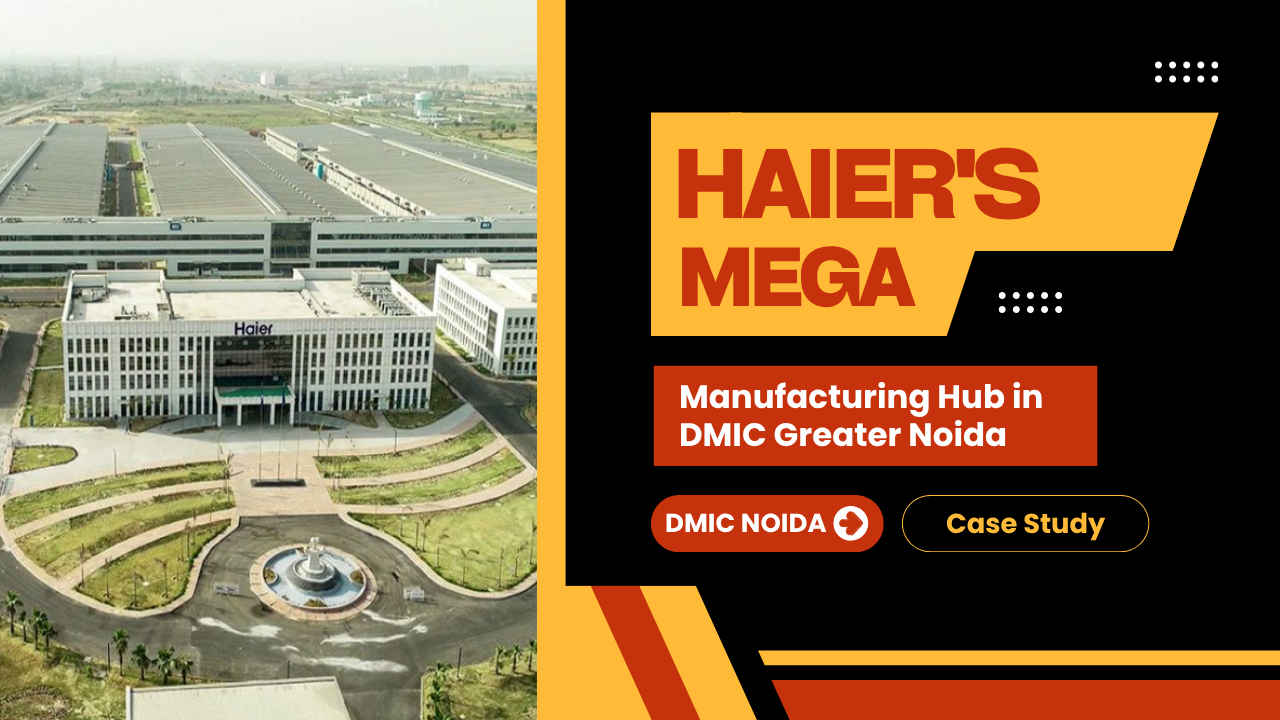
One of the most prominent examples is Haier Appliances India, which operates its Northern Industrial Park in the Integrated Industrial Township at Greater Noida.
Haier’s investment provides an important case study of how a global manufacturing company can use Greater Noida’s industrial infrastructure, NCR market access and supply-chain ecosystem to build and expand a large manufacturing operation in India.
Haier’s Greater Noida facility manufactures home appliances and related components and has continued to expand since its establishment. The company’s own information identifies the facility at Plot H-6 in the DMIC Integrated Industrial Township, Greater Noida.
More recently, Haier announced another major expansion involving more than ₹1,000 crore of additional investment between 2024 and 2028, including a new air-conditioner manufacturing facility and injection-moulding capabilities.
This makes Haier an important example of the industrial momentum developing within the DMIC Greater Noida region.
Haier in Greater Noida: An Overview
Haier entered the Greater Noida industrial ecosystem as part of its strategy to expand manufacturing in India and support the government’s Make in India initiative.
In 2018, Haier announced plans to establish its second industrial park in India at Greater Noida.
The company announced an investment of approximately ₹3,069 crore for the industrial park, to be developed in phases over four years.
The original plan covered approximately 123 acres and was proposed within the Integrated Industrial Township Greater Noida. Haier projected around 4,000 direct jobs and more than 10,000 indirect employment opportunities from the project.
The facility was planned for the production of major consumer-appliance categories including:
- Refrigerators
- Washing machines
- Air conditioners
- LED televisions
- Water heaters
- Related components
The original industrial park plan targeted substantial manufacturing capacity across several product categories.
1. Haier’s Investment in DMIC Greater Noida
Haier’s Greater Noida journey demonstrates how an initial large-scale manufacturing investment can evolve through multiple expansion phases.
Original Investment
In 2018, Haier announced an investment of approximately ₹3,069 crore for its Greater Noida industrial park.
The company planned to develop the project in two phases and expected the facility to strengthen local manufacturing of major home-appliance categories.
The investment was part of Haier’s broader India manufacturing strategy and was intended to reduce dependence on imports while increasing local production.
Phase II Expansion
Haier subsequently announced a second phase of development.
In 2023, the company announced an additional ₹400 crore investment for its Greater Noida plant.
This phase added approximately 44,890 square metres to the existing development and focused particularly on injection moulding and sheet-metal capabilities.
The company described the expansion as a move toward stronger backward integration and increased manufacturing capabilities.
Government officials later stated that the second phase was expected to create employment opportunities for approximately 1,000 people.
Latest Expansion
Haier announced another significant expansion in 2025.
The company said it would invest more than ₹1,000 crore between 2024 and 2028 in new facilities and expansion at its Greater Noida manufacturing operations.
The latest expansion includes a new air-conditioner manufacturing plant and an injection-moulding facility.
This shows that the Greater Noida facility is not simply a one-time investment. It has developed into a continuously expanding manufacturing base.
2. Haier’s Production Capacity
Production capacity is one of the most important indicators of the scale of Haier’s Greater Noida operation.
Haier’s current corporate information states that its Greater Noida industrial park has manufacturing capacity of approximately:
- 1 million air conditioners per year
- 2 million refrigerators per year
- 1 million washing machines per year
The facility is spread across approximately 122 acres, according to Haier’s current India corporate information.
This gives the existing facility a combined stated annual capacity of approximately 4 million units across these three major categories, before considering additional production from newer facilities and other product lines.
3. New Air Conditioner Manufacturing Capacity
Haier’s latest expansion could significantly increase its air-conditioner manufacturing capability in India.
The company announced that its upcoming AC manufacturing plant would have an annual capacity of 2.5 million units.
Haier stated that this would increase its total AC manufacturing capacity from approximately 1.5 million units to 4 million units annually.
This expansion is particularly significant because air conditioners are one of the fastest-changing segments of India’s consumer-appliance market.
The new facility is intended to help Haier respond to growing domestic demand while increasing local manufacturing.
According to the company, the new facility is also intended to support faster production cycles and reduce dependence on imported components.
4. Injection Moulding and Backward Integration
One of the most important aspects of Haier’s expansion is not simply increasing finished-product production.
The company is also strengthening its backward integration.
The injection-moulding facility allows Haier to manufacture important components used across its product categories.
This can provide several potential advantages:
- Greater control over component production
- Reduced dependence on imported components
- Better supply-chain coordination
- Potentially shorter production lead times
- Improved manufacturing flexibility
- Greater localisation of production
Haier has stated that around 90% of its appliances are manufactured locally in India, and the new facilities are intended to further strengthen localisation.
This is an important indicator of how an industrial location can evolve from an assembly-focused operation into a more integrated manufacturing ecosystem.
5. Employment Impact
Large manufacturing facilities create employment beyond the factory floor.
Haier’s Greater Noida operation contributes to employment through:
Direct Employment
Employees working directly for Haier across:
- Manufacturing
- Engineering
- Quality control
- Research and development
- Administration
- Supply chain
- Warehousing
- Maintenance
- Management
Indirect Employment
The industrial ecosystem also creates opportunities for:
- Component suppliers
- Logistics companies
- Packaging companies
- Contractors
- Maintenance providers
- Transport operators
- Warehousing companies
- OEM suppliers
- Service providers
When Haier announced the Greater Noida industrial park in 2018, it projected approximately 4,000 direct jobs and more than 10,000 indirect jobs.
Haier’s latest expansion announcement adds another 3,500 expected employment opportunities between 2024 and 2028.
The figures represent announced/projected employment associated with different investment phases and should not be added together automatically as a current headcount.
6. Haier’s Wider Supply-Chain Impact
The economic impact of a large manufacturing facility extends beyond its own campus.
A major appliance manufacturer requires an extensive network of suppliers.
This can include:
- Plastic components
- Sheet metal
- Electrical components
- Electronic parts
- Motors
- Compressors
- Packaging materials
- Printed circuit boards
- Logistics services
- Warehousing
- Maintenance services
Haier’s original Greater Noida investment was expected to create opportunities for vendors and OEMs while increasing local production and reducing import dependence.
This is one reason large anchor companies can be important for an industrial corridor.
Once an anchor manufacturer establishes operations, supporting companies may find it commercially attractive to locate nearby.
7. Why Haier Chose Greater Noida
Haier’s investment provides an interesting example of the location advantages offered by the Greater Noida industrial ecosystem.
The facility is located within the DMIC Integrated Industrial Township Greater Noida.
The township itself is a major DMIC project covering approximately 747.5 acres.
The Government of India describes the township as part of the Dadri-Noida-Ghaziabad Investment Region under DMIC and developed to promote manufacturing and industrial development.
Greater Noida also provides access to the broader NCR market.
For a consumer-appliance company, this combination is strategically important.
Haier can manufacture products in Greater Noida while being positioned close to a large domestic consumer market and a substantial network of suppliers, logistics providers and business services.
8. DMIC Infrastructure Supports Large-Scale Manufacturing
The Haier case demonstrates why industrial infrastructure matters.
The Integrated Industrial Township was created specifically to provide industrial infrastructure capable of attracting manufacturing investment.
Government documentation describes the township as a DMIC project intended to drive manufacturing and attract skilled human resources.
The wider Greater Noida industrial ecosystem also connects businesses with major road and freight networks.
This is particularly important for consumer appliances because products need to move through multiple stages:
Components → Manufacturing → Warehousing → Distribution → Retail/Customer
Efficient infrastructure can help companies manage these movements at scale.
9. From Manufacturing to a Localised Industrial Ecosystem
Haier’s development is significant because the company is moving beyond simply manufacturing finished appliances.
Its newer investments include component manufacturing and injection moulding.
This indicates a move towards greater localisation.
A simplified model of Haier’s evolving manufacturing ecosystem can be represented as:
Raw Materials
↓
Components
↓
Injection Moulding / Sheet Metal
↓
Appliance Manufacturing
↓
Quality & Testing
↓
Warehousing
↓
Distribution
↓
Indian & Export Markets
The greater the number of these functions that can be efficiently coordinated within the local supply chain, the stronger the manufacturing ecosystem can become.
10. Expansion Plans: What Comes Next?
Haier’s expansion plans demonstrate that the company’s Greater Noida presence is continuing to evolve.
The latest announcement covers more than ₹1,000 crore of additional investment between 2024 and 2028.
The expansion includes:
New AC Manufacturing Plant
A new facility with planned annual capacity of 2.5 million air conditioners.
Injection Moulding
A new facility to manufacture important components and strengthen backward integration.
Increased Local Manufacturing
Haier intends to further reduce dependence on imported components and increase local production.
Additional Employment
The company expects the latest investment programme to create approximately 3,500 additional employment opportunities.
Faster Supply Chains
Haier has stated that increased localisation is intended to improve production cycles and reduce supply-chain dependence on imports.
A NICDC report on the 2025 expansion stated that the new AC plant was expected to begin operations by December 2026.
Because this is an announced/projected timeline, it should be treated as a planned milestone rather than a guarantee of operational status on any particular date.
11. Haier’s Expansion Reflects Greater Noida’s Manufacturing Potential
Haier’s story is important for understanding the broader development of DMIC Greater Noida.
The company did not establish a small distribution facility.
It established a large manufacturing park and subsequently continued to invest in additional manufacturing and component capabilities.
This progression can be summarised as:
Initial Industrial Investment
↓
Large-Scale Manufacturing
↓
Phase II Expansion
↓
Backward Integration
↓
Component Manufacturing
↓
Additional AC Capacity
↓
Larger Local Supply Chain
This is precisely the type of industrial evolution that policymakers seek when developing manufacturing corridors.
12. Haier as a Case Study for Global Investment in DMIC Greater Noida
Haier’s Greater Noida operation can be viewed as an example of how a global company can establish a long-term manufacturing presence in India.
The case highlights several important factors.
1. Large Initial Investment
The original industrial park represented a multi-thousand-crore investment commitment.
2. Manufacturing at Scale
The facility has substantial annual production capacity across refrigerators, air conditioners and washing machines.
3. Localisation
The company has progressively increased local manufacturing and component capabilities.
4. Employment
The project supports direct employment as well as opportunities throughout its supplier ecosystem.
5. Expansion
The facility has continued to receive additional investment after the initial development.
6. Integration
Component manufacturing and backward integration are strengthening the overall manufacturing ecosystem.
13. Haier and the Future of Manufacturing in Greater Noida
The Haier example is particularly relevant as Greater Noida develops into a larger manufacturing and logistics centre.
A successful industrial corridor requires more than land.
It needs:
- Industrial infrastructure
- Power
- Water
- Roads
- Freight connectivity
- Logistics facilities
- Skilled workers
- Supplier ecosystems
- Market access
- Investment-friendly policies
The Integrated Industrial Township at Greater Noida was developed with the objective of creating this type of ecosystem.
Government data has previously highlighted Haier among major investors in the 747-acre IIT Greater Noida, alongside companies such as Hyosung, NLMK, Tata Chemicals and Amul.
This makes Haier more than an individual company story. It is an example of how the DMIC industrial ecosystem can attract and retain large manufacturing investments.
14. A Potential Model for Future Global Manufacturers
Haier’s development provides a possible template for other global manufacturers considering Greater Noida.
The model is relatively straightforward:
Establish a Manufacturing Base
↓
Build Local Supplier Network
↓
Increase Domestic Production
↓
Add Component Manufacturing
↓
Reduce Import Dependence
↓
Expand Production Capacity
↓
Serve Indian Markets
↓
Develop Export Opportunities
This approach can create deeper industrial linkages and potentially generate more economic value than a facility focused only on final assembly.
Conclusion: Haier’s Greater Noida Investment Is a DMIC Success Story
Haier’s manufacturing operation at Greater Noida is one of the clearest examples of the industrial transformation taking place within the DMIC ecosystem.
The company’s original Greater Noida industrial park involved a planned investment of approximately ₹3,069 crore, with projected employment of around 4,000 direct workers and more than 10,000 indirect workers.
The facility subsequently expanded through a ₹400 crore Phase II investment, focused on injection moulding and sheet metal capabilities.
Haier has now announced more than ₹1,000 crore of additional investment between 2024 and 2028, including a new AC manufacturing facility and injection-moulding capabilities. The new AC plant is planned to add 2.5 million units of annual capacity, taking Haier’s stated total AC capacity to approximately 4 million units annually.
The significance of Haier’s investment therefore goes beyond the number of factories or machines.
It demonstrates the potential of DMIC Greater Noida to develop large-scale manufacturing ecosystems, attract global companies, create employment, strengthen local supply chains and support India’s transition towards higher levels of domestic production.
As additional industrial and logistics infrastructure develops around Greater Noida and Dadri, companies such as Haier can become important anchor businesses within the region’s larger manufacturing ecosystem.
Haier Greater Noida: Key Numbers at a Glance
| Parameter | Details |
|---|---|
| Location | DMIC Integrated Industrial Township, Greater Noida |
| Industrial Park | Haier Northern Industrial Park |
| Land Area | Approximately 122–123 acres |
| Original Announced Investment | Approximately ₹3,069 crore |
| Phase II Investment | ₹400 crore |
| Latest Expansion Programme | More than ₹1,000 crore between 2024–2028 |
| Existing Refrigerator Capacity | 2 million units/year |
| Existing Washing Machine Capacity | 1 million units/year |
| Existing AC Capacity | 1 million units/year according to Haier’s current corporate profile |
| Planned AC Expansion | Additional 2.5 million units/year |
| Targeted AC Capacity After Expansion | Approximately 4 million units/year |
| Original Direct Employment Projection | Approximately 4,000 |
| Original Indirect Employment Projection | 10,000+ |
| Latest Additional Employment | Approximately 3,500 announced |
| Key Expansion Areas | AC manufacturing, injection moulding, localisation |
| Manufacturing Focus | Refrigerators, ACs, washing machines and related components |
Investment, capacity and employment figures above relate to different phases and announcements; they should not be treated as cumulative current headcount or as a single-period investment figure.
Frequently Asked Questions
Where is Haier’s manufacturing plant in Greater Noida?
Haier’s Northern Industrial Park is located at Plot H-6 within the DMIC Integrated Industrial Township, Greater Noida, Uttar Pradesh.
How much did Haier originally invest in Greater Noida?
Haier announced an investment of approximately ₹3,069 crore in 2018 for its Greater Noida industrial park.
What does Haier manufacture in Greater Noida?
The Greater Noida facility manufactures major home appliances including refrigerators, air conditioners and washing machines, along with related components and newer injection-moulding capabilities.
What is Haier’s production capacity in Greater Noida?
Haier’s current corporate information lists annual capacities of approximately 2 million refrigerators, 1 million air conditioners and 1 million washing machines. The company’s latest AC expansion is planned to add another 2.5 million units annually.
How many jobs has Haier’s Greater Noida project created?
Different phases have different employment projections. The original industrial park announcement projected approximately 4,000 direct and more than 10,000 indirect jobs, while the latest 2024–2028 expansion programme announced approximately 3,500 additional employment opportunities.
Is Haier expanding its Greater Noida plant?
Yes. Haier announced more than ₹1,000 crore of additional investment between 2024 and 2028, including a new AC manufacturing facility and injection-moulding capabilities.
Why is Haier important for DMIC Greater Noida?
Haier demonstrates how a global manufacturer can establish a large-scale production base inside the DMIC Integrated Industrial Township and subsequently expand manufacturing, component production and local supply-chain capabilities.
buying property DMIC Greater Noida Dadri DFC Dadri logistics hub Dadri MMLH DMIC 2030 DMIC companies in Greater Noida DMIC connectivity DMIC corridor investment DMIC electronics industry DMIC employment opportunities DMIC Greater Noida DMIC Greater Noida 2030 DMIC Greater Noida 2040 DMIC Greater Noida airport DMIC Greater Noida apartments DMIC Greater Noida companies DMIC Greater Noida connectivity DMIC Greater Noida development DMIC Greater Noida industries DMIC Greater Noida investment DMIC Greater Noida jobs DMIC Greater Noida logistics DMIC Greater Noida property DMIC Greater Noida residential demand DMIC Integrated Township DMIC real estate investment Godrej DMIC Greater Noida Godrej Global Business City Godrej Properties Greater Noida Godrej residential development Greater Noida industrial corridor Greater Noida industrial development Greater Noida industrial investment Greater Noida logistics hub Greater Noida logistics infrastructure Greater Noida manufacturing hub Greater Noida warehousing Hero Homes DMIC Contact Number Hero Homes DMIC Floor Plans Hero Homes DMIC Master Plans Hero Homes DMIC Payment Plan Integrated Industrial Township Greater Noida logistics companies Greater Noida manufacturing Greater Noida MMLH Greater Noida