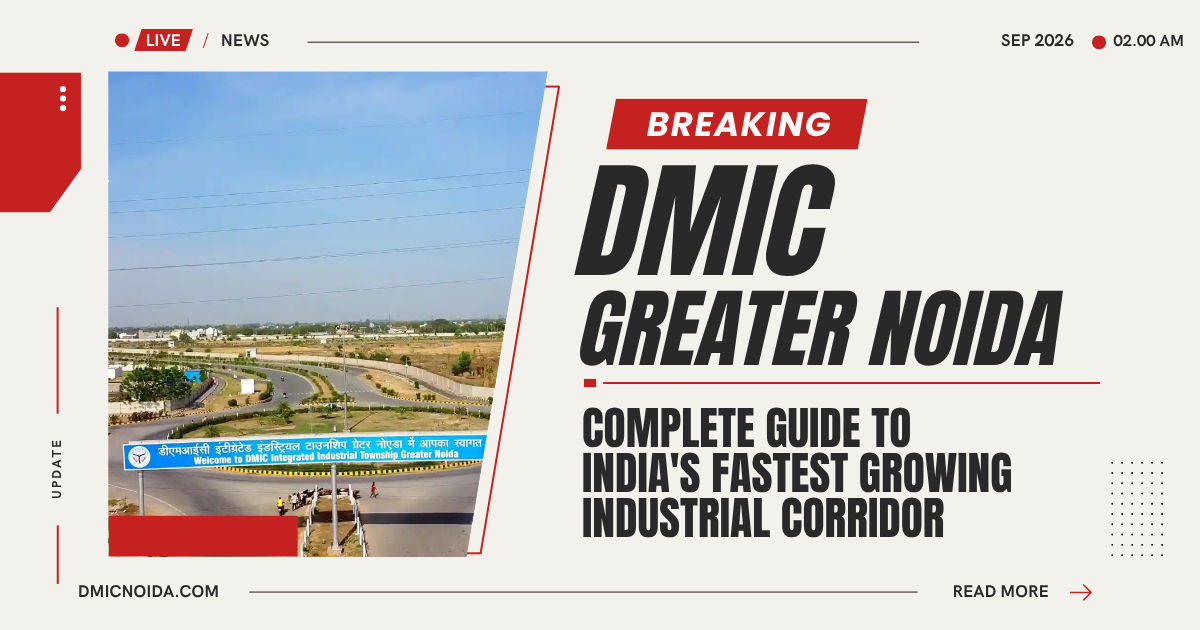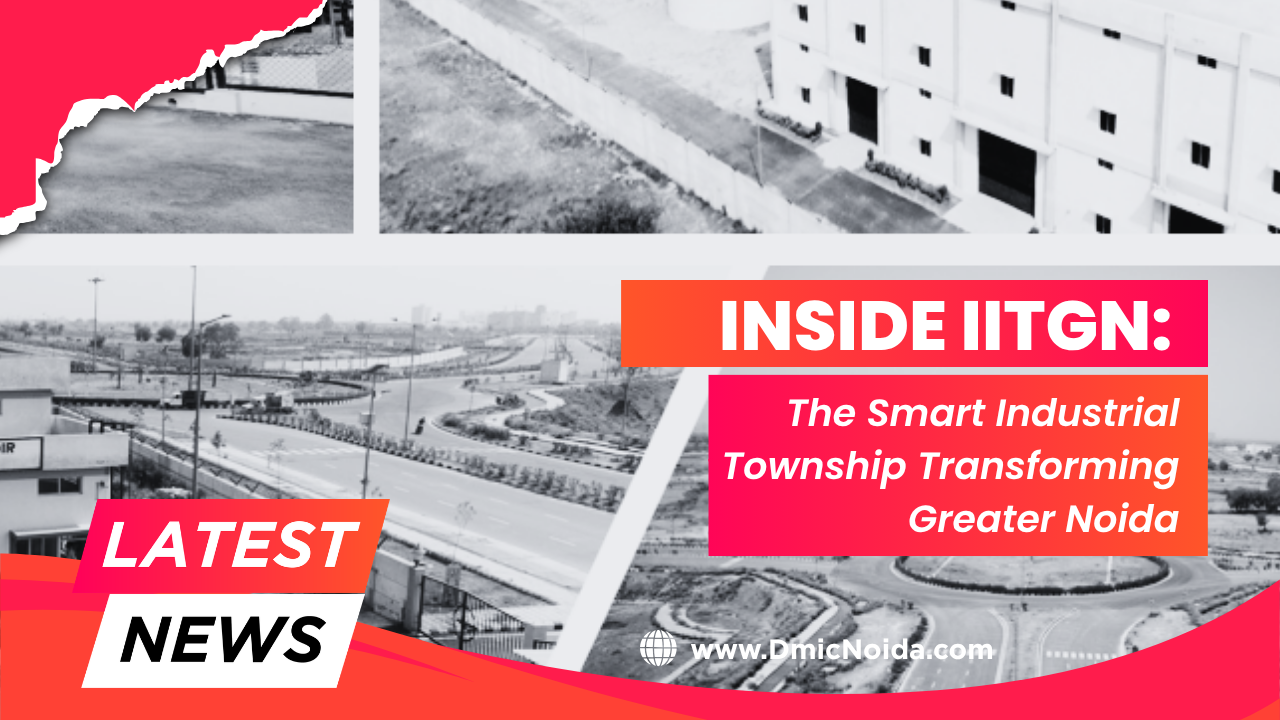
IITGN Greater Noida, or the Integrated Industrial Township Greater Noida, is one of the flagship industrial development projects associated with the Delhi Mumbai Industrial Corridor (DMIC).
Located within the Dadri-Noida-Ghaziabad Investment Region (DNGIR), IITGN has been planned as a modern industrial township combining manufacturing, commercial activity, residential development, green spaces, smart utilities and technology-enabled infrastructure.
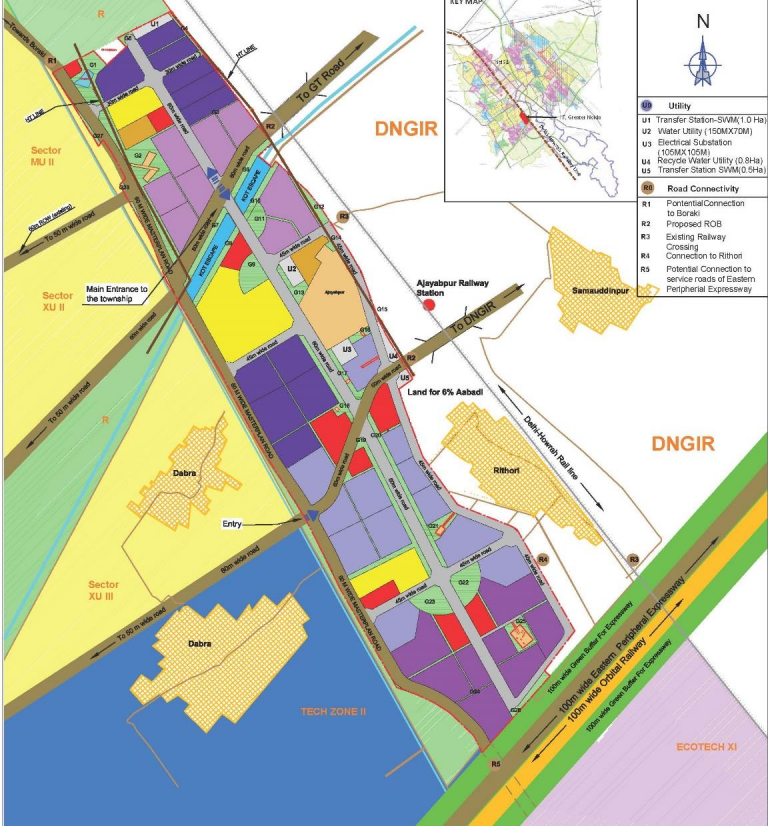
The township covers approximately 302.63 hectares, equivalent to around 747.5 acres. Its location on the south-eastern side of Greater Noida gives it strategic access to the Delhi-Howrah Railway Line and the Eastern Peripheral Expressway, while the wider area is connected with the NCR’s road, rail and logistics network.
Unlike a conventional industrial estate where companies may have to arrange many infrastructure services themselves, IITGN has been designed around a plug-and-play industrial infrastructure model.
The objective is to provide businesses with modern infrastructure at the plot level so that companies can focus more on their core operations.
IITGN Greater Noida at a Glance
| Feature | Details |
|---|---|
| Project | Integrated Industrial Township Greater Noida |
| Short Name | IITGN |
| Location | Greater Noida, Uttar Pradesh |
| Region | DNGIR |
| Corridor | Delhi Mumbai Industrial Corridor |
| Area | Approximately 747.5 acres |
| Project Type | Smart Integrated Industrial Township |
| Industrial Infrastructure | Plug-and-play |
| Water Supply | 24×7 planned supply |
| Power | Dedicated electrical substations |
| Waste Management | Automated Waste Collection System |
| Digital Infrastructure | OFC and Wi-Fi |
| Utility Monitoring | SCADA |
| Road Network | 80m, 60m, 45m and 30m roads |
| Railway Connectivity | Delhi-Howrah Railway Line |
| Road Connectivity | Eastern Peripheral Expressway and regional highway network |
The project is managed through DMIC Integrated Industrial Township Greater Noida Limited (IITGNL), a joint venture structure involving the central government side through the DMIC framework and the Government of Uttar Pradesh represented by GNIDA.
Why IITGN Is Important for Greater Noida
Greater Noida has already developed into an important residential, commercial and industrial centre in the NCR.
IITGN adds another layer to this growth by creating a dedicated, planned industrial ecosystem.
The concept is based on bringing together:
Manufacturing
Industrial Infrastructure
Smart Utilities
Logistics
Commercial Development
Residential Facilities
Digital Connectivity
Sustainability
This integrated approach is intended to make IITGN more than just an industrial land parcel.
The official vision is to develop a world-class, globally competitive, sustainable, smart and safer integrated industrial township within DNGIR.
747.5 Acres of Planned Industrial Development
One of the defining characteristics of IITGN is its scale.
The township covers approximately 747.5 acres.
Government records have identified the entire 747.5-acre area for the Integrated Industrial Township project at Greater Noida.
The current IITGNL documentation describes the land-use composition across the township, including industrial land, commercial/mixed-use areas, residential group housing and EWS housing, utilities and green open spaces. An IITGNL project document identifies approximately 50.78% of the township for industrial land, with additional areas allocated to commercial/mixed use, residential development and green/open spaces.
This mixed land-use structure is important.
A modern industrial city cannot function effectively with factories alone.
Workers and businesses also require:
- Housing
- Retail
- Open spaces
- Utilities
- Roads
- Public facilities
- Commercial services
- Transportation
IITGN’s planning model therefore attempts to combine industrial activity with supporting urban infrastructure.
Strategic Location of IITGN
Location is one of the biggest advantages of IITGN.
The township is approximately 11 km by road from Pari Chowk, Greater Noida, according to IITGNL.
It also adjoins the Delhi-Howrah Railway Line, while the Eastern Peripheral Expressway runs along the southern side of the project area. Ajayabpur Railway Station is located near the eastern side of the site.
The location provides access to the wider NCR transportation network.
Important connectivity advantages include:
- Delhi-Howrah Railway Line
- Eastern Peripheral Expressway
- Greater Noida road network
- Noida-Greater Noida connectivity
- Yamuna Expressway
- National highways
- Dadri logistics ecosystem
- Boraki transport ecosystem
Recent Government of India material also highlights IIT-GN’s proximity to the Boraki transit hub and Dadri logistics hub, along with access to major airports including IGI and Noida International Airport.
IITGN and the DMIC
IITGN is an early and important project associated with the Delhi Mumbai Industrial Corridor.
DMIC is intended to strengthen India’s manufacturing and services ecosystem through large-scale infrastructure development.
The wider DMIC approach includes:
- Industrial cities
- High-capacity transportation
- Logistics infrastructure
- Reliable utilities
- Manufacturing facilities
- Skill development
- Smart infrastructure
IITGNL describes DMIC’s broader objective as expanding India’s manufacturing and services base and developing it as a global manufacturing and trading hub.
IITGN therefore represents the industrial-city component of this larger economic-development strategy.
IITGN Infrastructure: Built for Modern Industry
One of the biggest differences between IITGN and a conventional industrial estate is its planned infrastructure ecosystem.
The official IITGNL infrastructure information lists several major components.
These include:
- Wide roads
- Service lanes
- Cycle tracks
- Underground utility ducts
- Automated waste collection
- 24×7 water supply
- Water recycling
- Dedicated electrical substations
- Optical fibre network
- Public Wi-Fi
- SCADA monitoring
- CCTV surveillance
- Integrated command and control systems
The objective is to provide businesses with reliable infrastructure without requiring every company to independently develop basic services.
Wide Roads and Planned Road Network
The IITGN road system has been planned with a hierarchy of wide roads.
The official infrastructure plan includes:
- 80-metre roads
- 60-metre roads
- 45-metre roads
- 30-metre roads
This hierarchy allows traffic to be distributed between major sector roads and internal streets.
The newer IITGNL industrial scheme also describes roads with separate service lanes and dedicated cycle tracks.
For an industrial township, road width is particularly important because the area needs to accommodate:
- Employee traffic
- Commercial vehicles
- Industrial transport
- Service vehicles
- Emergency services
- Pedestrian movement
- Future traffic growth
Underground Utility Network
Another important feature of IITGN is the planned use of underground utility ducts.
Instead of creating a landscape filled with overhead infrastructure, utilities are designed to be organised below ground.
This can help with:
- Better visual appearance
- Easier maintenance
- Reduced surface-level infrastructure clutter
- Better utility management
- Future infrastructure upgrades
The IITGNL industrial scheme specifically identifies underground utility ducts as part of the township’s state-of-the-art infrastructure.
24×7 Water Supply
Reliable water infrastructure is essential for modern industrial development.
IITGN’s infrastructure is designed for 24×7 water supply.
IITGNL lists a design water capacity of approximately 21.94 MLD for the township.
The project also incorporates water recycling and reuse as part of its sustainability and utility-management approach.
This is particularly important for industrial companies because reliable water availability can directly affect operational continuity.
Water Recycling and Reuse
IITGN’s infrastructure concept goes beyond supplying fresh water.
The project has been planned around water treatment, recycling and reuse.
The official IITGNL material describes 100% recycling and reuse of water as part of the township’s infrastructure concept.
The earlier IITGN planning material also describes a zero-waste-discharge approach involving treatment of wastewater for non-potable and industrial reuse.
The objective is to reduce:
- Freshwater consumption
- Wastewater discharge
- Infrastructure losses
- Long-term environmental impact
Smart Power Infrastructure
Reliable electricity is one of the most important requirements for manufacturing.
IITGN has dedicated electrical infrastructure designed to support industrial operations.
The official infrastructure specifications include:
220/33 kV electrical substation
and
33/11 kV electrical distribution network.
The industrial scheme describes the system as supporting 24×7 high-quality power supply, with solar-powered street lighting also incorporated into the infrastructure concept.
For businesses, reliable power infrastructure can reduce dependence on individual backup arrangements and support continuous operations.
Smart Utility Management Through SCADA
One of IITGN’s most important smart-city features is SCADA.
SCADA stands for:
Supervisory Control and Data Acquisition.
It is used for monitoring and managing infrastructure and utility systems.
At IITGN, SCADA is incorporated into the utility-management framework.
This can help operators monitor:
- Water systems
- Utility networks
- Infrastructure performance
- Distribution systems
- Operational parameters
- Potential faults
The result is a more technology-driven approach to managing an industrial township.
Automated Waste Collection System
Waste management is another area where IITGN uses smart infrastructure.
The township includes an Automated Waste Collection System (AWCS).
The system is designed to improve the collection and movement of solid waste through an organised infrastructure network.
IITGNL lists a design solid-waste capacity of approximately 60.3 tonnes per day.
This becomes increasingly important as industrial, commercial and residential populations grow.
Optical Fibre and Digital Connectivity
A modern industrial city needs digital infrastructure just as much as physical infrastructure.
IITGN has been planned with an optical fibre network across the township.
The official industrial scheme also identifies Wi-Fi at public places as part of the digital infrastructure.
Digital connectivity can support:
- Businesses
- Data communication
- Security systems
- Smart utility management
- Digital governance
- Industrial operations
- Public services
Integrated Command and Control Centre
IITGN’s smart-city concept also includes an Integrated ICT Command and Control Centre.
The purpose of such a system is to bring multiple technology-enabled services into an integrated monitoring environment.
The IITGNL infrastructure documentation identifies:
- CCTV surveillance
- Integrated ICT command and control
- SCADA
- Digital land management
as components of its smart governance framework.
This creates a more coordinated approach to managing the township.
Smart Governance and E-Land Management
Technology is also being used for investor and land-management processes.
IITGN has an e-Land Management System intended to digitise land-related applications, allotment processes, certificates, approvals and investor records.
IITGNL also highlights the Uttar Pradesh Single Window Clearance System for facilitating investors.
For industrial investors, digital systems can reduce paperwork and make application and monitoring processes more structured.
Industrial Zones at IITGN
IITGN is not planned as one uniform industrial zone.
Its layout incorporates different land parcels and industrial development concepts.
The official IITGNL infrastructure planning material identifies potential areas for different types of industrial activities, including:
- Hi-Tech industries
- Bio-Tech industries
- Green/non-polluting industries
- Research and development
- Other industrial activities
The hi-tech industrial areas are planned along major roads and in locations intended to maximise visibility and connectivity.
Hi-Tech Industries
Hi-tech industries are an important component of the IITGN industrial planning concept.
The IITGNL infrastructure documentation identifies Hi-Tech Type A industries in selected land parcels.
These are generally envisioned as compact, lower-rise industrial structures, with building heights described as up to approximately 10 metres in the planning material.
The positioning of these plots along major roads can provide:
- Better visibility
- Better access
- Easier movement
- Proximity to developed urban areas
- Connectivity to future DNGIR linkages
Biotechnology and R&D
IITGN’s industrial planning also provides for Bio-Tech industries.
Research and development activities can be particularly important in a modern industrial ecosystem because they encourage:
- Innovation
- Technology development
- Product improvement
- Industry-academia collaboration
- Advanced manufacturing
IITGNL’s land-development policy identifies collaboration between industries and educational institutions as one of the objectives of the township.
Green and Non-Polluting Industries
Current IITGNL industrial land-allotment schemes have included industrial plots under Green Non-Polluting Industrial Land Use, including biotechnology and R&D categories.
A September 2025 IITGNL scheme listed plot sizes ranging from approximately 11,993 sq m to 63,610 sq m for such industrial use.
This indicates a focus on attracting industries compatible with the township’s planned environmental and infrastructure framework.
Because allotment schemes and plot availability can change, businesses should always verify the latest IITGNL notification before relying on specific plot sizes or availability.
Plug-and-Play Infrastructure at IITGN
The term “plug-and-play” is one of the most important concepts associated with IITGN.
But what does it actually mean?
In simple terms, plug-and-play infrastructure means that essential infrastructure and utilities are already planned and made available so that an industrial company does not have to create every basic facility from scratch.
IITGNL states that services are made available at the plot level, making the infrastructure a complete plug-and-play environment.
What Does Plug-and-Play Mean for Businesses?
A company setting up a manufacturing facility generally needs:
- Road access
- Electricity
- Water
- Drainage
- Sewerage
- Waste management
- Digital connectivity
- Security
- Utility connections
In a conventional undeveloped industrial area, a business may need to invest significant time and money arranging these services.
At IITGN, the infrastructure has been designed to provide these systems through an integrated township framework.
This can potentially reduce:
- Initial infrastructure burden
- Development time
- Utility coordination
- Operational complexity
Plug-and-Play Infrastructure: Major Components
The IITGN model includes:
Electricity
Dedicated power infrastructure and distribution network.
Water
24×7 planned water supply.
Sewerage
Dedicated sewerage infrastructure with planned treatment capacity.
Waste Management
Automated waste collection.
Roads
Wide internal and sector roads.
Digital Connectivity
Optical fibre and public Wi-Fi infrastructure.
Utility Monitoring
SCADA-based monitoring.
Security
CCTV surveillance and command-and-control infrastructure.
Together, these systems create an integrated business environment.
Why Plug-and-Play Matters for Manufacturing
Time is an important factor in industrial investment.
A company investing in a manufacturing facility wants to move from:
Land Acquisition
to
Construction
to
Production
as efficiently as possible.
The more infrastructure is already available, the fewer basic systems a company needs to establish independently.
This is one of the reasons modern industrial corridors increasingly focus on plug-and-play infrastructure.
IITGN for MSMEs and Large Industries
The township can potentially accommodate businesses of different scales, depending on applicable land-allotment schemes and eligibility.
Potential users can include:
- Manufacturing companies
- Technology businesses
- Engineering companies
- R&D organisations
- Biotechnology companies
- Industrial suppliers
- Export-oriented businesses
- Green industries
- Supporting industries
The exact plot categories, sizes, land-use permissions and allotment conditions should always be checked against the latest IITGNL scheme.
IITGN and Ease of Doing Business
Infrastructure alone does not create a successful industrial city.
Companies also need an efficient administrative environment.
IITGN incorporates technology-enabled systems intended to support investors.
These include:
Single Window Clearance
E-Land Management
Digital Records
Online Applications
Smart Utility Management
The objective is to allow investors to spend more time on their business and less time navigating fragmented administrative processes.
Residential and Commercial Development Within IITGN
Although IITGN is primarily an industrial township, its planning is not limited to industrial plots.
The land-use structure includes:
- Industrial areas
- Commercial/mixed-use areas
- Residential group housing
- EWS housing
- Green/open spaces
- Utility areas
The 747.5-acre planning framework therefore attempts to create a more complete urban ecosystem around employment and industry.
This is important because industrial employees require access to housing, retail and social infrastructure.
Green Spaces and Urban Environment
A modern industrial township cannot be designed entirely around concrete and factories.
IITGN’s land-use plan includes substantial green/open-space allocation.
The project document identifies approximately 15.76% of the township as green open space.
Green infrastructure can help create:
- Better environmental quality
- Improved visual appearance
- Public spaces
- Buffer areas
- More comfortable working environments
IITGN and the Greater Noida Manufacturing Ecosystem
IITGN is being developed in a region that already has an established manufacturing base.
The land-development policy states that IITGN has been conceptualised to harness the potential of the existing manufacturing cluster in Greater Noida and strengthen Greater Noida and Noida as manufacturing destinations in the NCR.
This creates the possibility of an industrial ecosystem where companies can benefit from proximity to:
- Suppliers
- Skilled labour
- Logistics operators
- Technology companies
- Service providers
- Existing manufacturers
- NCR consumers
IITGN and Logistics Connectivity
Industrial manufacturing is closely connected with logistics.
Factories need raw materials.
Finished products need to reach markets.
Exporters need access to freight networks.
IITGN’s location near the Delhi-Howrah railway line, Eastern Peripheral Expressway and the broader Dadri logistics ecosystem gives it strategic transportation advantages.
The wider DNGIR development also includes the proposed Multi Modal Logistics Hub at Dadri.
This creates the potential for an integrated:
Manufacturing + Logistics + Freight
ecosystem.
IITGN and Boraki Connectivity
The proposed/ongoing development around Boraki is another important component of the wider DNGIR ecosystem.
The Boraki Multi Modal Transport Hub is intended to integrate multiple passenger transportation modes.
IITGN’s proximity to this wider transportation ecosystem can support movement of employees and businesses.
The Government of India has specifically identified IIT-GN’s proximity to the Boraki transit hub as one of its connectivity advantages.
IITGN: A Smart Industrial City Model
The larger vision behind IITGN is to demonstrate how industrial development can be combined with smart-city principles.
The model can be summarised as:
Industrial Land
↓
Plug-and-Play Infrastructure
↓
Smart Utilities
↓
Digital Connectivity
↓
Employment
↓
Residential Development
↓
Commercial Ecosystem
↓
Integrated Urban Growth
This makes IITGN different from a conventional industrial estate.
Future Potential of IITGN Greater Noida
The long-term potential of IITGN depends on several factors.
Industrial Occupancy
More businesses establishing operations can increase economic activity.
Employment
Industrial companies can create direct and indirect employment.
Logistics
Improved freight connectivity can strengthen supply chains.
Infrastructure
Continued development of roads and utilities can increase the attractiveness of the township.
Commercial Growth
A growing workforce can create demand for retail and services.
Residential Development
Employees and businesses can create demand for housing.
Why Companies May Consider IITGN
For companies evaluating industrial locations in the NCR, IITGN offers several potential advantages.
Strategic NCR Location
Access to Delhi and the broader NCR market.
Existing Industrial Ecosystem
Proximity to established Greater Noida industrial areas.
Planned Infrastructure
Modern roads and utility networks.
Plug-and-Play Approach
Infrastructure available at plot level.
Digital Infrastructure
OFC, Wi-Fi and smart utility management.
Freight Connectivity
Access to railway and regional logistics infrastructure.
Large Planned Township
Approximately 747.5 acres of integrated development.
IITGN vs Traditional Industrial Estate
| Feature | Traditional Industrial Estate | IITGN |
|---|---|---|
| Industrial plots | Yes | Yes |
| Wide planned roads | Varies | Yes |
| Underground utilities | Varies | Planned |
| 24×7 water | Varies | Planned |
| Smart utility monitoring | Limited/varies | SCADA |
| Automated waste collection | Usually limited | Yes |
| Digital connectivity | Varies | OFC/Wi-Fi |
| Dedicated power infrastructure | Varies | Yes |
| Plug-and-play model | Limited | Core concept |
| Integrated residential planning | Limited | Yes |
| Commercial/mixed use | Varies | Planned |
| Smart governance | Varies | E-Land/ICT systems |
IITGN Investment Perspective
IITGN can be important not only for manufacturers but also for the wider Greater Noida investment ecosystem.
Industrial development can create secondary demand for:
- Housing
- Rental properties
- Retail
- Restaurants
- Hotels
- Offices
- Warehouses
- Professional services
However, investors should distinguish between industrial infrastructure potential and guaranteed real estate appreciation.
Being near IITGN does not automatically mean a property will appreciate.
The actual investment case depends on:
- Exact location
- Authority
- Land use
- Legal title
- RERA status where applicable
- Infrastructure status
- Connectivity
- Existing demand
- Pricing
- Holding period
Current Development and Land-Allotment Activity
IITGNL continues to publish industrial land schemes and infrastructure-related announcements.
For example, its 2025 industrial scheme invited applications for green/non-polluting industrial land, including biotechnology and R&D uses. IITGNL has also continued publishing infrastructure, tender and township-related announcements in 2026.
This continuing administrative and development activity is important because it indicates that IITGN is progressing through actual land-allotment and infrastructure processes rather than existing only as a conceptual DMIC project.
For businesses and investors, however, the latest official scheme should always be checked before making decisions because land availability, plot categories and application dates can change.
The Future of IITGN
The future of IITGN is linked to the broader transformation of Greater Noida into a major industrial and economic centre.
The development of:
- IITGN
- DNGIR
- Dadri logistics infrastructure
- Boraki transport infrastructure
- Dedicated Freight Corridors
- Greater Noida expressway connectivity
- Yamuna Expressway ecosystem
- Noida International Airport
can create a wider network of industrial and economic activity.
The real potential lies not in any single project but in the interaction between these infrastructure systems.
Why IITGN Could Become an Important Industrial Hub
A successful industrial hub generally requires five things:
1. Location
IITGN is located within the NCR and close to major transportation infrastructure.
2. Infrastructure
The township has planned roads, utilities, water, power and waste-management systems.
3. Connectivity
Rail, expressway and logistics connectivity support movement of goods and people.
4. Workforce
Greater Noida and the surrounding NCR provide access to a large labour and professional market.
5. Business Ecosystem
Manufacturers, logistics companies, suppliers and service providers can create a network around the industrial hub.
IITGN has been designed around these principles.
Why IITGN Matters to Greater Noida
IITGN Greater Noida represents a new generation of industrial development in the NCR.
Spread across approximately 747.5 acres, the Integrated Industrial Township combines industrial land with commercial, residential, green and utility infrastructure.
Its most important differentiator is the emphasis on smart, integrated and plug-and-play infrastructure.
The township includes planned:
- 80m, 60m, 45m and 30m roads
- 24×7 water supply
- Dedicated power infrastructure
- Underground utilities
- SCADA monitoring
- Automated waste collection
- Optical fibre connectivity
- Public Wi-Fi
- CCTV surveillance
- Integrated command and control
- Digital land-management systems
These features are intended to create an environment where companies can establish operations with modern infrastructure already available at the plot level.
Its location adds another major advantage.
The township is positioned close to the Delhi-Howrah Railway Line, Eastern Peripheral Expressway, Boraki transportation ecosystem and Dadri logistics ecosystem.
For Greater Noida, IITGN can therefore become more than an industrial estate.
It can serve as a model for how manufacturing, logistics, smart infrastructure, employment and urban development can be integrated within one planned township.
As industrial investment increases across the DMIC and DNGIR region, IITGN is likely to remain an important project to watch for businesses, manufacturers, logistics companies and investors looking at the long-term growth of Greater Noida.
Frequently Asked Questions About IITGN Greater Noida
What is IITGN Greater Noida?
IITGN stands for Integrated Industrial Township Greater Noida, a flagship industrial township associated with the Delhi Mumbai Industrial Corridor and located within DNGIR.
How large is IITGN Greater Noida?
IITGN covers approximately 302.63 hectares, or around 747.5 acres.
Where is IITGN located?
IITGN is located in the south-eastern part of Greater Noida, approximately 11 km by road from Pari Chowk. It is adjacent to the Delhi-Howrah Railway Line and the Eastern Peripheral Expressway corridor.
What does plug-and-play infrastructure mean at IITGN?
It means key infrastructure and utilities are planned to be available at the industrial plot level, allowing businesses to establish operations without having to independently develop all basic infrastructure systems.
What industries can be developed at IITGN?
The township planning includes industrial categories such as hi-tech industries, biotechnology, R&D and green/non-polluting industrial uses, subject to the applicable land-use and allotment conditions.
Does IITGN have smart infrastructure?
Yes. IITGNL identifies SCADA monitoring, automated waste collection, CCTV surveillance, ICT command and control, optical fibre connectivity and digital land-management systems among its smart infrastructure features.
Does IITGN have residential development?
The overall township land-use plan includes residential group housing and EWS housing in addition to industrial, commercial/mixed-use, green and utility areas.
Is IITGN part of DMIC?
Yes. IITGN is a flagship project associated with the Delhi Mumbai Industrial Corridor and is located within the DNGIR framework.
Is IITGN good for industrial investment?
The township has been designed specifically to facilitate industrial and commercial investment. Businesses should nevertheless evaluate the latest land-allotment scheme, applicable land use, infrastructure availability, approvals and commercial feasibility before investing.
buying property DMIC Greater Noida Dadri DFC Dadri logistics hub Dadri MMLH DMIC 2030 DMIC companies in Greater Noida DMIC connectivity DMIC corridor investment DMIC electronics industry DMIC employment opportunities DMIC Greater Noida DMIC Greater Noida 2030 DMIC Greater Noida 2040 DMIC Greater Noida airport DMIC Greater Noida apartments DMIC Greater Noida companies DMIC Greater Noida connectivity DMIC Greater Noida development DMIC Greater Noida industries DMIC Greater Noida investment DMIC Greater Noida jobs DMIC Greater Noida logistics DMIC Greater Noida property DMIC Greater Noida residential demand DMIC Integrated Township DMIC real estate investment Godrej DMIC Greater Noida Godrej Global Business City Godrej Properties Greater Noida Godrej residential development Greater Noida industrial corridor Greater Noida industrial development Greater Noida industrial investment Greater Noida logistics hub Greater Noida logistics infrastructure Greater Noida manufacturing hub Greater Noida warehousing Hero Homes DMIC Contact Number Hero Homes DMIC Floor Plans Hero Homes DMIC Master Plans Hero Homes DMIC Payment Plan Integrated Industrial Township Greater Noida logistics companies Greater Noida manufacturing Greater Noida MMLH Greater Noida