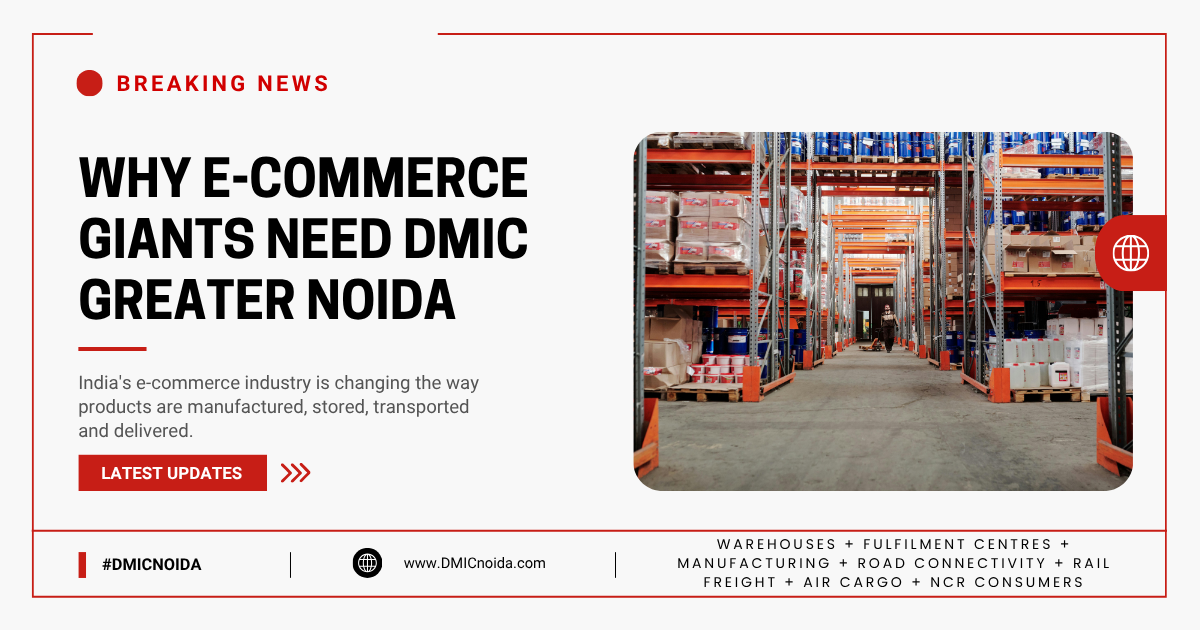
India’s e-commerce industry is changing the way products are manufactured, stored, transported and delivered. Customers increasingly expect faster delivery, accurate inventory availability and convenient return services. For e-commerce companies, this makes location and logistics infrastructure just as important as technology.
This is where DMIC Greater Noida can become strategically important.
Greater Noida sits within the wider Delhi-NCR market and is surrounded by major highways, expressways, industrial areas, manufacturing clusters and emerging logistics infrastructure. The region is also connected to the Dedicated Freight Corridor ecosystem and is close to the emerging Noida International Airport cargo infrastructure.
For large e-commerce companies, this creates the possibility of combining:
Warehouses + Fulfilment Centres + Manufacturing + Road Connectivity + Rail Freight + Air Cargo + NCR Consumers
The Uttar Pradesh government identifies e-commerce hubs, warehousing facilities, logistics parks, real-time logistics, robotics and automation among the opportunities in the state’s logistics sector.
Why Location Matters to E-Commerce Companies
E-commerce is fundamentally a logistics business.
A customer may place an order through an app or website, but behind that simple transaction is a complex network:
Supplier
↓
Manufacturing Facility
↓
Warehouse
↓
Fulfilment Centre
↓
Sorting
↓
Transportation
↓
Last-Mile Delivery
↓
Customer
Every additional kilometre, transfer or delay can affect the economics of the order.
This is why e-commerce companies prefer locations that allow them to serve large consumer markets from strategically positioned fulfilment and distribution centres.
Greater Noida offers several of these characteristics.
1. NCR Reach Is the Biggest Advantage
One of the strongest advantages of Greater Noida is its access to the National Capital Region.
A large fulfilment centre located in the Greater Noida region can potentially serve customers across:
- Greater Noida
- Noida
- Delhi
- Ghaziabad
- Faridabad
- Gurgaon
- Western Uttar Pradesh
- Haryana
- Rajasthan and other northern markets
The region’s road connectivity makes it possible to connect warehouses with multiple NCR markets.
This is especially important for high-volume e-commerce categories such as:
- Electronics
- Fashion
- Home appliances
- Furniture
- Consumer goods
- Beauty products
- Grocery
- Personal care
- Lifestyle products
2. Same-Day Delivery Depends on Warehouse Location
Same-day delivery is not achieved only through faster delivery vehicles.
It starts with inventory being located close to customers.
Suppose a customer in Noida orders a television.
If the product is stored in a fulfilment centre several hundred kilometres away, the company has limited options for delivering it on the same day.
But if the inventory is already positioned in the NCR region, the final delivery journey can be considerably shorter.
This creates a simple principle:
Closer Inventory = Shorter Delivery Distance
This is why major e-commerce companies build networks of regional fulfilment centres instead of relying on one national warehouse.
Greater Noida’s location gives it potential to serve as one of these regional distribution nodes.
3. Greater Noida Can Support Regional Fulfilment Centres
A large fulfilment centre needs more than warehouse space.
It requires:
- Large floor plates
- Truck access
- Loading bays
- Parking
- Power
- Digital connectivity
- Security
- Labour
- Road connectivity
- Nearby suppliers
- Access to consumers
Industrial and logistics development around Greater Noida can support many of these requirements.
The wider Uttar Pradesh logistics strategy specifically identifies warehousing, e-commerce hubs, logistics parks, digital logistics and robotics/automation as investment opportunities.
4. Warehouse Clusters Can Create a Logistics Network
One isolated warehouse cannot create a complete logistics ecosystem.
A cluster of warehouses can be much more valuable.
Imagine a logistics zone containing:
- E-commerce fulfilment centres
- Third-party logistics companies
- Cold storage
- Packaging companies
- Transportation operators
- Courier companies
- Freight forwarders
- Distribution centres
- Component suppliers
Once these businesses locate near one another, logistics operations can become more interconnected.
This can create a warehouse cluster.
Greater Noida and the wider DMIC ecosystem have the potential to develop this type of network as industrial and logistics activity expands.
5. Why E-Commerce Needs Multiple Warehouse Layers
Modern e-commerce does not depend on a single warehouse.
It uses different levels of inventory.
National Fulfilment Centre
Stores large quantities of products and serves multiple states.
Regional Fulfilment Centre
Serves a region such as NCR or northern India.
Sortation Centre
Organises shipments according to destination.
Last-Mile Delivery Centre
Moves products to individual customers.
Greater Noida can be particularly relevant to the regional fulfilment and distribution layer because of its proximity to NCR.
6. DMIC Greater Noida and Same-Day Delivery
Same-day delivery requires coordination between inventory, technology and transportation.
A simplified system looks like:
Customer Order
↓
Nearest Inventory Identification
↓
Fulfilment Centre
↓
Automated Sorting
↓
Delivery Vehicle
↓
Customer
The closer the fulfilment centre is to the customer, the more practical rapid delivery becomes.
Greater Noida’s position within NCR therefore gives it an advantage for companies targeting high-density consumer markets.
7. E-Commerce + Manufacturing: A Powerful Combination
Greater Noida is not only becoming a logistics location.
It is also developing as a manufacturing centre.
The region has major electronics, consumer-appliance and industrial manufacturing activity.
This creates an interesting opportunity for e-commerce companies.
A manufacturer can produce products near Greater Noida.
Those products can then move into a nearby warehouse.
From the warehouse, they can be distributed to customers throughout NCR and northern India.
The supply chain can therefore become:
Manufacturing
↓
Regional Warehouse
↓
Fulfilment
↓
NCR Distribution
↓
Customer
This reduces the distance between production and consumption.
8. Electronics E-Commerce Could Benefit Strongly
The Greater Noida–Noida region already has a strong electronics manufacturing ecosystem.
That creates an opportunity for electronics-focused e-commerce logistics.
Consider products such as:
- Smartphones
- Televisions
- Refrigerators
- Washing machines
- Air conditioners
- Laptops
- Computer accessories
- Smart-home products
Many of these products are manufactured or assembled within the wider NCR ecosystem.
A logistics cluster near the manufacturing base can support:
Factory → Warehouse → E-Commerce Fulfilment → Customer
This can be particularly useful during major shopping periods when inventory movement increases sharply.
9. Large Warehouses Need Excellent Road Connectivity
Warehousing is only useful if trucks can reach it efficiently.
Greater Noida is connected to several major road corridors, while the wider DMIC ecosystem includes the Eastern Peripheral Expressway, Noida-Greater Noida Expressway and Yamuna Expressway.
These connections provide access to different parts of NCR and northern India.
For e-commerce companies, this is important because delivery networks need multiple routes rather than dependence on one road.
10. Dadri Logistics Hub Adds Another Layer
The planned Multi-Modal Logistics Hub at Dadri adds another important component to the region’s logistics ecosystem.
Dadri is strategically positioned near the Eastern and Western Dedicated Freight Corridors.
The combination of:
Greater Noida Warehousing
Dadri MMLH
DFC
Expressways
can create a wider logistics network supporting both domestic distribution and longer-distance freight.
This is important because e-commerce companies increasingly operate at national scale.
11. Noida International Airport Creates an Air-Cargo Advantage
The development of Noida International Airport adds another dimension to the e-commerce ecosystem.
The airport began commercial operations in June 2026 and has dedicated cargo infrastructure. Its initial cargo capacity is stated at 200,000 metric tonnes annually, with plans to scale to 1.5 million tonnes. The airport also says its warehousing and logistics zone will provide flexibility to e-commerce players and freight forwarders.
This is particularly relevant for products where speed matters.
For example:
- Electronics
- High-value products
- Fashion
- Time-sensitive shipments
- International e-commerce
- Premium consumer goods
Air cargo can complement road and rail freight rather than replace them.
12. Air + Road + Rail Creates a Stronger E-Commerce Ecosystem
The future logistics model around Greater Noida could involve several transportation modes.
Road
For last-mile and regional delivery.
Rail
For high-volume and longer-distance freight.
Air
For time-sensitive and high-value cargo.
Warehousing
For inventory management and fulfilment.
This creates a multimodal logistics ecosystem.
Noida International Airport’s cargo terminal has been designed around integration of air, road and rail connectivity, according to the airport operator.
13. Automation Will Become Increasingly Important
Large e-commerce warehouses are increasingly automated.
Future fulfilment centres can use:
- Conveyor systems
- Automated sorting
- Warehouse management systems
- Robotics
- Barcode scanning
- AI-based inventory management
- Automated picking
- Digital tracking
Uttar Pradesh’s logistics investment framework specifically identifies robotics and automation as opportunities within the logistics sector.
Greater Noida’s industrial and technology ecosystem can support this transition.
14. Warehouse Clusters Can Attract 3PL Companies
Third-party logistics companies are critical to e-commerce.
Many online retailers do not operate every warehouse and transportation operation themselves.
Instead, they outsource logistics to 3PL providers.
A mature warehouse cluster can therefore attract:
- 3PL companies
- Courier companies
- Freight forwarders
- Packaging companies
- Cold-chain operators
- Fleet operators
- Technology providers
This creates additional employment and investment.
15. Reverse Logistics Is Another Major Requirement
E-commerce is not only about delivering products.
Returns are equally important.
A product may be:
Delivered → Returned → Inspected → Repacked → Restocked
This requires specialised reverse-logistics infrastructure.
A large logistics ecosystem near NCR can support these operations.
This is particularly important in categories such as:
- Fashion
- Electronics
- Lifestyle
- Home products
16. Why DMIC Greater Noida Could Become an E-Commerce Logistics Hub
The region has several components that e-commerce companies need:
Consumer Market
Large NCR customer base.
Warehousing
Growing demand for regional distribution facilities.
Manufacturing
Large industrial ecosystem.
Roads
Multiple expressway and highway connections.
Rail Freight
DFC connectivity through the Dadri region.
Air Cargo
Noida International Airport.
Logistics Hub
MMLH at Dadri.
Workforce
Access to the wider NCR labour market.
This combination creates a compelling logistics proposition.
17. The E-Commerce Growth Model
The development can be visualised as:
Manufacturers
↓
Warehouse Clusters
↓
Fulfilment Centres
↓
Sortation Centres
↓
Last-Mile Delivery
↓
NCR Customers
At the same time:
International Suppliers
↓
Air / Rail / Road
↓
Greater Noida Logistics Ecosystem
↓
E-Commerce Warehouse
↓
Indian Customer
This is why DMIC Greater Noida can become increasingly important to e-commerce supply chains.
Conclusion: Why E-Commerce Giants Need DMIC Greater Noida
The future of e-commerce depends on speed, scale and supply-chain efficiency.
Greater Noida offers an increasingly attractive combination of NCR market access, manufacturing, warehousing, expressway connectivity, freight infrastructure and air-cargo development.
The arrival of Noida International Airport strengthens this proposition further. Its cargo infrastructure has been specifically designed to support freight forwarders, e-commerce players and North India’s wider logistics ecosystem.
For e-commerce companies, the opportunity is not simply to build another warehouse.
It is to create an integrated network where:
Manufacturing + Warehousing + Fulfilment + Road + Rail + Air Cargo
operate within the same regional ecosystem.
That is what could make DMIC Greater Noida one of North India’s important future e-commerce and logistics destinations.